
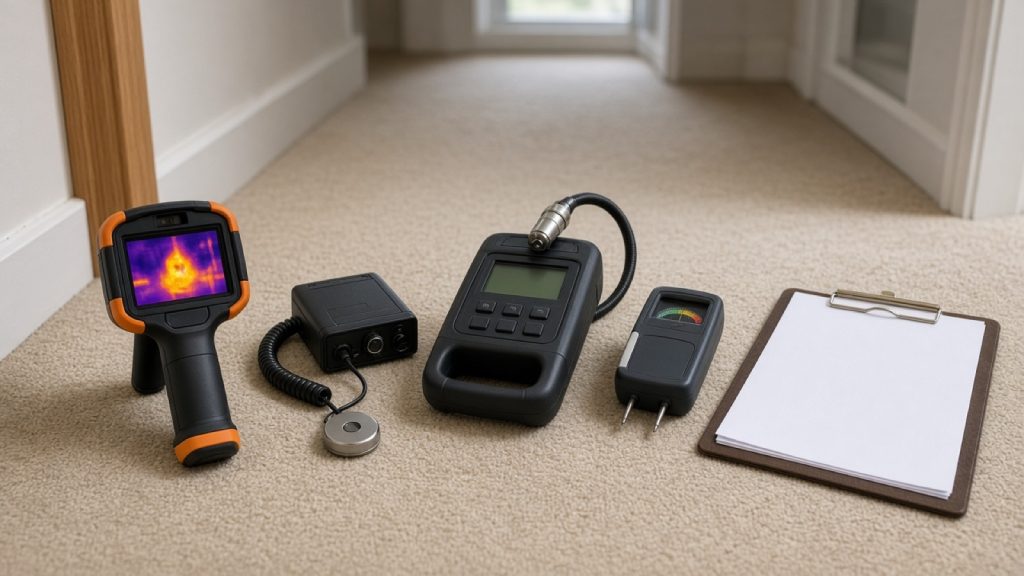
You have a leak somewhere, or a strong suspicion of one, and before you ring anyone you want to know what leak detection cost looks like. That is a fair question. The honest answer is that there is no single price, because it is not a single job. Finding a split pipe under a drive is different work from finding a weeping joint on a heating circuit under a tiled floor.
This article explains what moves the price, what a good quote should include, what no find, no fee means in practice, and where your home insurance usually comes in. We do not print figures here, because a figure that fits one house would mislead the next. By the end you will know the questions to ask any detection company, and how to tell a fair quote from a vague one.
What you are paying for
A leak detection visit is an investigation, not a repair. You are paying for an engineer's time, for the equipment brought to the house, and for a written answer at the end: where the leak is, what it is on, and the evidence that proves it. The equipment is the expensive part. A thermal camera, a ground microphone and a tracer gas kit are specialist tools that a general plumber does not carry.
The point of the visit is to replace guesswork with one marked spot. Without it, the alternative is to lift floors or dig the drive in the places that seem likely, and keep going until the pipe is found. Most people who ask about price have already had a quote for that approach, and the detection visit is the cheaper route because the opening up is limited to one place.
What moves the leak detection cost up or down
The first factor is the type of system. A leak on the cold mains is found with different tools from a leak on the heating circuit, and each takes a different amount of time. The second is the size and layout of the property. A two bedroom terrace with one bathroom is a shorter job than a large detached house with three bathrooms, underfloor heating and a long supply pipe across the garden.
The third is access. Pipes under a solid concrete floor, behind tiled walls or beneath a block paved drive take longer to trace than pipes under a suspended timber floor with a hatch. The fourth is how much is already known. If you have done the meter test and the boiler pressure check before we arrive, the job starts from a narrower set of possibilities and finishes sooner.
The last factor is which methods the job needs. Some leaks are found with the thermal camera alone. Others need the heating circuit drained and filled with tracer gas, or the supply pipe route traced before the acoustic survey begins. A quote that assumes one method and then adds others on the day is the kind to be wary of.
• Type of system: mains, heating, underfloor or bathroom
• Size and layout of the property
• Access: concrete floors, tiling, drives, basements
• How much you already know from your own checks
• Which methods the job needs, and whether more than one
Water mains and underground leaks
When people search for water leak detection cost UK wide, the leak they usually have is on the supply pipe between the boundary stop tap and the house. It is underground, it leaves nothing to see, and the meter keeps turning with every tap off. The price for this work depends on the length of the pipe, whether the route is known, and what is on top of it.
A short run under a lawn is straightforward. A long run under a tarmac drive, a conservatory base and a patio takes more time, because the ground microphone has to be worked along the full route and the surface changes how the sound carries. Underground water leak detection cost also rises if the pipe route has to be traced first, which is often the case on older houses where the pipe does not run in a straight line.
What you should expect at the end is one marked point on the surface, a reading that supports it, and a written note of what was done. The repair itself, usually a section of new pipe or a full replacement with the meter company's agreement, is a separate job and a separate quote.
Central heating and underfloor heating leaks
Central heating leak detection cost is driven by how the leak has to be confirmed and then pinpointed. The first step is a pressure test on the circuit to prove the water is leaving the system and not the boiler. Then the thermal camera is used with the heating hot, which shows the pipe runs through the floor and the wider warm patch where water has spread.
If the camera gives a clear answer, the job stops there. If the pipe is deep in a screed or the leak is small, the circuit is drained and filled with tracer gas, and a detector follows the gas to the break. That adds time and materials, which is why a heating job can be priced differently from a mains job on the same house.
Underfloor heating is a special case. Each loop is isolated at the manifold to find the one that will not hold pressure, and then the camera and tracer gas are used on that loop only. The result is one tile or one board lifted rather than a whole floor, which is where the saving against guesswork is biggest.
Why no find, no fee changes the sum
We work on a no find, no fee basis. If the leak is not located on the visit, you do not pay for the visit. That puts the risk on us rather than on you, and it changes how you should read a quote. A company that charges for the visit whatever the outcome has no reason to be careful about which jobs it takes on.
It is worth being clear about what no find, no fee does not mean. It does not mean the repair is included. It does not mean making good the floor or wall is included. It means the detection part of the job is only charged when it delivers an answer. Ask any company you ring to say in plain words what happens if nothing is found.
What a good quote should include
A fair quote is given before anyone arrives, is for a fixed sum, and says what that sum covers. You should not be discovering the price for the first time when the engineer is standing in your kitchen. If the company cannot give a figure on the phone once you have described the property and the symptoms, ask why.
The quote should also name the methods that are included. If thermal imaging, acoustic listening and tracer gas are all available on the visit, that should be stated, so you are not told on the day that the one tool the job needs is extra. The written report should be included as standard, because it is the document your insurer will ask for.
• A fixed price agreed on the phone before the visit
• Which methods are included on that visit
• Whether the written report is included
• What happens if a second visit is needed
• What is not included: the repair and making good
• Whether VAT is included in the figure given
What home insurance usually covers
Most buildings policies include trace and access cover. In general terms it pays for the cost of finding a leak and for putting right whatever had to be opened up to reach it, when the leak is one the policy covers. The damage the water has done is usually dealt with under the escape of water part of the same policy.
What trace and access does not usually cover is the repair of the pipe or fitting itself. That is treated as maintenance. Policies differ, so read your own schedule and ring your insurer before the visit, so the claim is open and they know a report is coming. Our report is written with that claim in mind: photographs, readings, the method used and the exact location.
How to get an accurate price on the phone
People who ring asking how much does leak detection cost UK wide get a much more useful answer once they can describe the problem. Before you call, do the meter test: everything off, read the meter, wait 20 minutes, read it again. Note the boiler pressure in the morning and again at night. Note where any damp shows and what the floor is made of.
Then tell us the type of property, the number of bathrooms, whether there is underfloor heating, and what is on top of the supply pipe route. With that, we can say which methods the job will need and give you a fixed figure for the visit. We can usually book you in within 24 to 48 hours, and the visit runs no find, no fee.