Continuous flow on the meter
Meters log flow around the clock. A reading that never drops to zero, even at 3 am, triggers the company's letter. Shut the internal stop tap: if the meter still moves, the leak is outside.

Supply pipe leaks
From the stop tap at your boundary to the kitchen tap, the supply pipe is yours to maintain. When it leaks, Charlie proves it, traces it and marks the point for repair, usually within 24 to 48 hours of your call.
Boundary to house covered
Pinpointed before digging
No find, no fee
Report for the water company
Tell us what you have noticed and where. We ring you back to talk it through. No find, no fee.
No find, no fee
24/7 enquiries
Non-invasive methods
Reports for insurance claims
Every property has a mains supply pipe running from the water company's stop tap, usually in the pavement, to the internal stop tap under the sink. The water company owns the pipe up to the boundary and you own the rest. When it leaks, finding it is down to you.
Water main leak detection on a private supply pipe is mostly an underground job. The pipe can be lead, galvanised steel, plastic, or a mix where someone has repaired it before. Joints and the entry point into the building are the usual failures.
Charlie's main water leak detection service covers the whole run: confirming the loss at the meter, pressure testing the supply pipe on its own, tracing where it goes, and pinpointing the leak with ground microphones and tracer gas, in one visit.
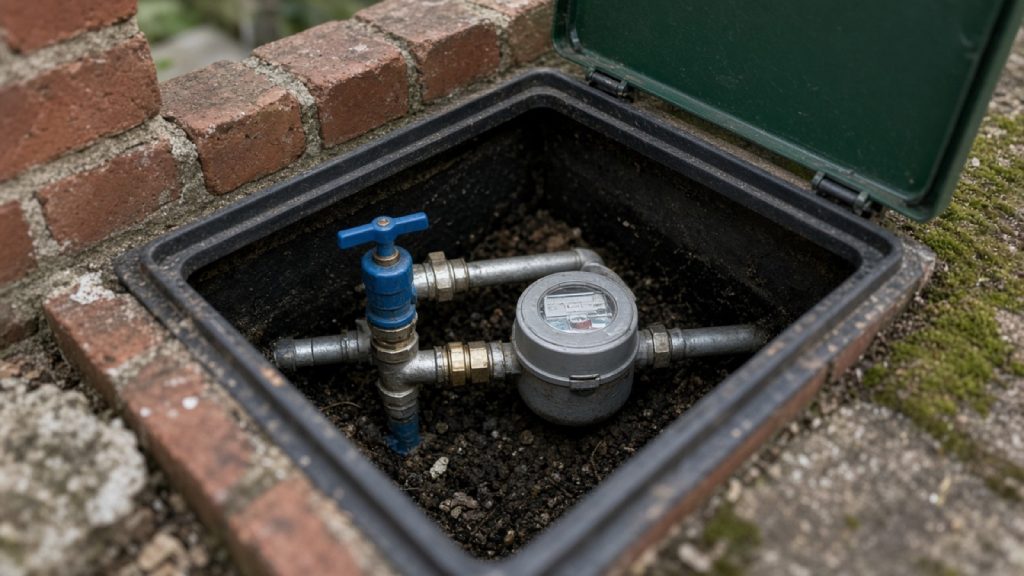
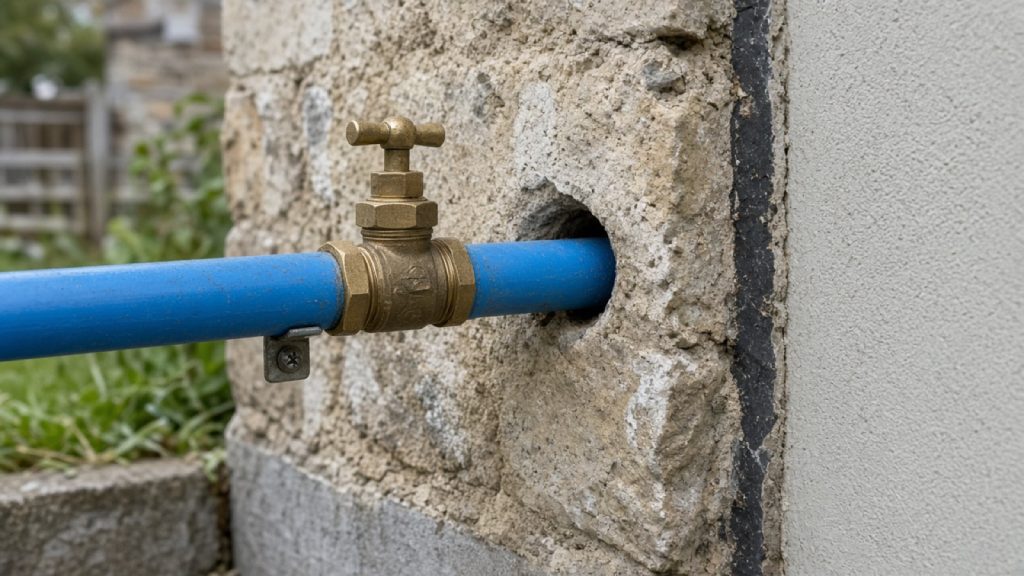
Meters log flow around the clock. A reading that never drops to zero, even at 3 am, triggers the company's letter. Shut the internal stop tap: if the meter still moves, the leak is outside.
A leak on the mains pipe affects the whole house. If the shower and the kitchen cold tap have both lost force, and the neighbours have not, look at the supply pipe first.
Water sitting in the meter chamber, a damp line along the path, or a puddle that reappears outside the front wall in dry weather. The supply pipe usually takes the shortest line to the house.
A supply pipe leak close to where it enters the building shows as damp at the base of a wall, under the kitchen units or in the hall, where the pipe comes through the slab.
1
With the internal stop tap closed, the meter shows whether the supply pipe is losing water and how fast. A pressure test on the isolated pipe confirms it. This takes about 20 minutes.
2
Charlie locates the route and depth from the boundary to the entry point. Metal pipe is traced electromagnetically; plastic pipe with a sonde or by following the tracer gas. The route is marked on the ground.
3
Ground microphones along the marked route first, then tracer gas where the pipe is plastic, deep or under hard standing. The leak is painted and measured, and the report records the readings, the route and the mark.
A ground microphone amplifies the hiss of water escaping from a pressurised pipe. The sound carries along metal pipe and through firm ground, so on a short run under a lawn this often finds the leak.
The supply pipe is drained and charged with a hydrogen and nitrogen mix. The gas escapes at the leak and rises to the surface where the detector reads it, the reliable way to find a leak on plastic pipe.
An electromagnetic locator finds the route and depth of a metal supply pipe. For plastic, a sonde is fed in from the stop tap, or the gas plume shows the line. The pipe is marked before listening.
A test gauge on the isolated supply pipe shows whether it holds pressure and how quickly it falls. The rate of loss gives a fair idea of the hole size, and whether a repair or a replacement makes sense.
A semi in King's Lynn had the water company's letter about continuous flow and no damp anywhere. With the internal stop tap closed the meter kept turning, and the ground microphone followed the metal supply pipe under the front garden to a corroded joint a few metres from the boundary box, marked for one dig. In Leigh-on-Sea a 1930s house had low pressure at every tap and a wet line along the path in dry weather; the plastic pipe was traced with a sonde and tracer gas rose over the leak under the block paving. In Wisbech a shared supply pipe on a terrace was proved to be leaking on the common length, which settled who paid.
We cover Suffolk, Norfolk, Cambridgeshire and Essex every week, with Hertfordshire, Bedfordshire, Buckinghamshire and Greater London by arrangement. Whichever water company has written to you, the pipe is surveyed the same way, usually within 24 to 48 hours.
Short, practical reads written for the problem you have in front of you.
Many home policies cover the supply pipe under trace and access or a separate underground pipe section, and some water companies offer a one off repair or a leakage allowance once the leak is fixed. Both want evidence of where the leak is and how it was found, and the report gives the readings, route, mark and photographs.
Call 07897 020 680 with the meter reading and we will say what the next step is and get you booked in.
Landline 01440 840 772. Email hello@completeleakdetection.co.uk.