A water bill that has jumped
Usage climbs with no change in the household, or the water company writes to say your consumption looks high. The extra water is going somewhere, usually into the ground.

Leak detection specialist
A hidden leak shows up as a wet patch, a high bill or a meter that will not stop. Charlie finds the pipe behind it with thermal imaging, acoustic listening and tracer gas, then tells you where to open up.
No find, no fee
Non-invasive methods
Insurance-ready written report
Visits within 24 to 48 hours
Tell us what you have noticed and where. We ring you back to talk it through. No find, no fee.
No find, no fee
24/7 enquiries
Non-invasive methods
Reports for insurance claims
Complete Leak Detection is a leak detection specialist based in Suffolk. Charlie covers Norfolk, Suffolk, Cambridgeshire, Essex, Hertfordshire, Bedfordshire, Buckinghamshire and Greater London, and he answers the phone himself, day or night. Most visits are booked within 24 to 48 hours of your call.
The job is tracing water leaks nobody can see: a supply pipe under the drive, a heating pipe in a concrete floor, a joint behind a tiled wall. Each visit uses the method that suits the pipe and the building, so you are not paying for holes in the wrong place.
We provide professional leak detection services for private homes, landlords and commercial premises. If you need commercial water leak detection services for a shop, office, school or warehouse, the same equipment and the same engineer turn up, with the survey timed around your trading hours.
Usage climbs with no change in the household, or the water company writes to say your consumption looks high. The extra water is going somewhere, usually into the ground.
A patch on a wall, ceiling or skirting that dries out when the heating is on and returns a week later. Damp from a pipe takes no notice of the weather.
Turn off every tap and appliance, then watch the meter for 10 minutes. If the dial still turns, water is leaving the system somewhere between the meter and the taps.
Taps that have lost their force, or a hiss you can hear in a quiet room at night. Both point to water escaping under pressure from a pipe you cannot see.
1
Charlie asks what you have noticed, when it started, how the property is plumbed and whether you have a meter reading. That conversation usually narrows the search to one or two pipe runs before anyone arrives.
2
On site, the first task is to confirm the leak is real and to tell a supply pipe leak from a heating leak or a waste leak. Meter checks and pressure tests on each isolated section do that.
3
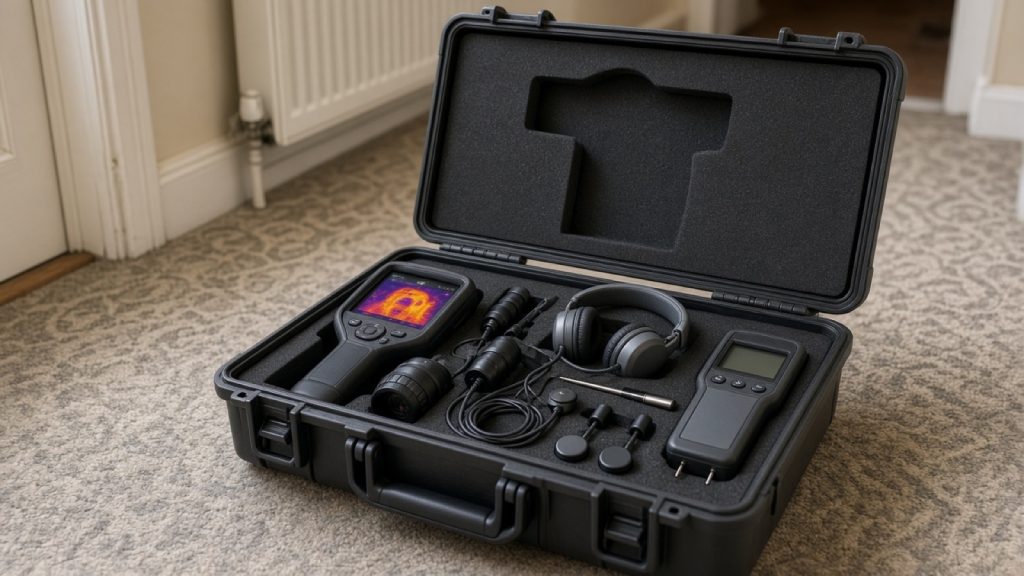
The confirmed section gets the right tool: thermal imaging for warm pipes, acoustic listening for pressurised cold water, tracer gas for anything buried or in concrete. The leak is marked, photographed and written up for your insurer.
An infrared camera shows the temperature of every surface in the room. A hot water or heating leak shows as a warm plume on a floor or wall, long before it is damp enough to feel.
Ground and contact microphones amplify the sound of water escaping under pressure. We listen along the pipe route and follow the sound to its loudest point, which is where the pipe has failed.
A safe mix of hydrogen and nitrogen is put into the drained pipe. The gas escapes at the leak and rises through soil, screed and tiles, and a hand held detector finds where it surfaces.
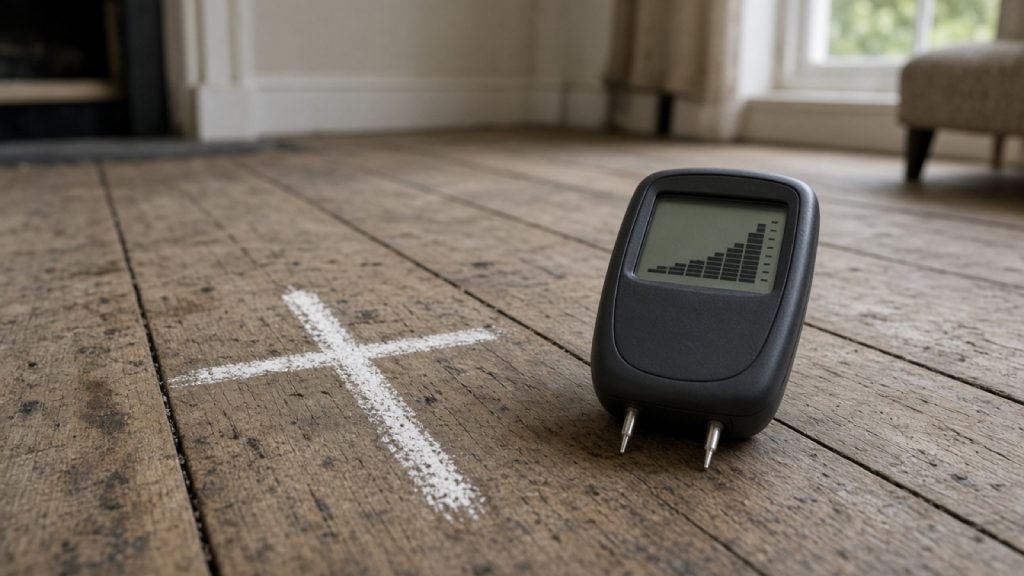
A meter reads the water content of plaster, screed and timber. Mapping the readings across a floor shows how far the water has travelled, which tells us whether the source is in that room at all.
A bungalow on the north Norfolk coast had a meter turning with everything off, and the ground microphone along the supply pipe found a split under the block paved drive. In a Mid Suffolk farmhouse the boiler needed topping up every few days; with the system hot the thermal camera showed a warm fan under the kitchen screed, and tracer gas confirmed a pinhole at a joint. In Ely a converted house had water appearing in a ground floor flat, and testing each flat's pipework in turn traced it to a shared riser. In Leigh-on-Sea a 1930s semi had a cold feed weeping behind the hall plaster, found as a cool stripe on the camera.
We work from the Suffolk and Essex border, which puts Cambridge, Bury St Edmunds and Chelmsford within an hour. Norfolk, Hertfordshire, Bedfordshire, Buckinghamshire and Greater London are covered by arrangement, with most visits booked within 24 to 48 hours.
Short, practical reads written for the problem you have in front of you.
Most home insurance policies include trace and access cover, which pays for finding the leak and for making good afterwards. Your insurer will ask for evidence. Our written report gives the leak location, the method used, photographs and thermal images, and a plain description of the damage, in one document.
Call 07897 020 680 any time, or 01440 840 772 in office hours, and we can usually book you in within 24 to 48 hours.
Landline 01440 840 772. Email hello@completeleakdetection.co.uk.