Pressure gauge keeps falling
The gauge on the boiler drops over days rather than months, and you have got into the habit of opening the filling loop. Each top up adds fresh water, and fresh water adds corrosion.

Heating system leaks
If you are topping the boiler up every few days, the water is going somewhere. Charlie traces the heating circuit with thermal imaging and tracer gas and marks the leaking pipe, usually without lifting a floorboard.
Floors stay down
No find, no fee
Thermal imaging and tracer gas
Booked within 24 to 48 hours
Tell us what you have noticed and where. We ring you back to talk it through. No find, no fee.
No find, no fee
24/7 enquiries
Non-invasive methods
Reports for insurance claims
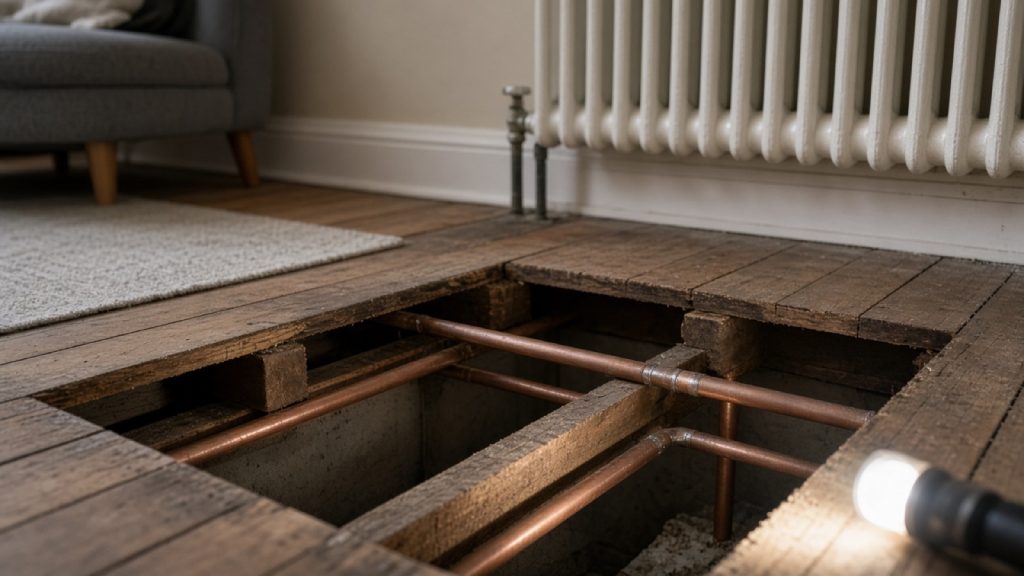
A sealed heating system should hold its pressure for months. When the gauge creeps down from 1.5 bar to zero every week, there is a hole in the circuit. It might be a pinhole in a copper pipe under a chipboard floor, or a plastic pipe nicked by a screw when the floor went down.
Central heating leaks are hard to see because the pipework runs under floors and through walls, and because warm water evaporates quickly off a warm pipe. A leak can run for a winter and leave nothing but a soft floorboard.
Heating leak detection is about finding that one point without opening every floor in the house. Charlie isolates the circuit radiator by radiator, uses the warm water in the pipes with a thermal camera, and puts tracer gas through anything heat cannot show.
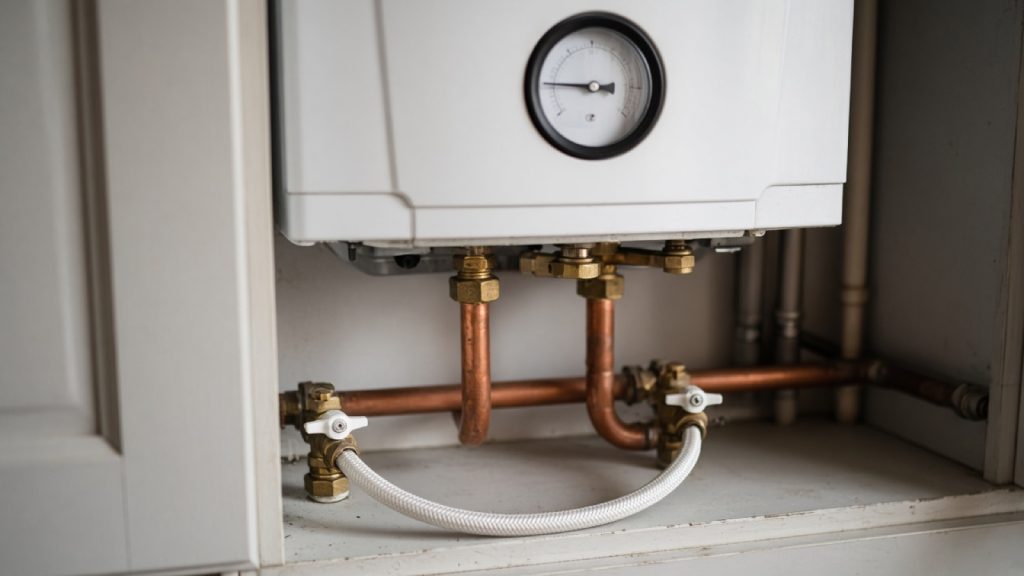
The gauge on the boiler drops over days rather than months, and you have got into the habit of opening the filling loop. Each top up adds fresh water, and fresh water adds corrosion.
Most modern boilers shut down below about 0.5 bar and show a fault code. If the lockout keeps coming back after a top up, the system is losing water rather than air.
Air gets in where water gets out. A radiator that is cold at the top again a few days after bleeding usually means a leak on the circuit is drawing air into the system.
A patch on a ceiling below a bathroom, a floorboard that has gone soft, or laminate lifting near a radiator pipe run. Heating leaks are warm, so the patch often feels dry.
1
Charlie checks the pressure relief valve, the expansion vessel and the boiler internals first, because a tired expansion vessel can mimic a leak. Then every radiator valve, bleed point and visible joint is inspected.
2
Valving off radiators and zones one at a time shows which part of the circuit is losing water. On a two storey house that usually brings the search down to one floor and a few metres of pipe.
3
With the heating on, the thermal camera shows the pipe route under the floor and any warm spread beside it. If the leak is too small to show as heat, tracer gas finds the point.
4
The leak is marked on the floor or wall and photographed. Charlie explains what failed and what the repair involves, and the written report follows with the thermal images for your insurer.
Heating pipes are warmer than the floor around them, so an infrared camera shows the pipe route through carpet, laminate or tiles. A leak appears as a warm bloom spreading sideways from the line of the pipe.
The circuit is drained and filled with a hydrogen and nitrogen mix. The gas finds the hole and rises through screed, concrete and floor finishes to the surface, where a detector picks it up above the leak.
Each isolated section is held at test pressure and watched. A section that holds is cleared, a section that drops is the one to trace, and the rate of drop gives a fair idea of the leak size.
Where the pipe is accessible or in a void, a contact microphone on the pipe picks up the sound of water escaping under pressure. It is quickest on exposed pipe runs in airing cupboards, lofts and cellars.
A 1960s house in Ipswich was losing a bar of pressure a week with no radiator wet. With the system hot, the thermal camera showed a warm fan spreading from a pipe run under the hall screed, and tracer gas confirmed a pinhole where the pipe turned to the lounge. In a Victorian terrace in St Albans the heating had been added under suspended floors, and a joint under the back bedroom was found through the boards with the camera and a contact microphone. In a Dalston flat the leak was behind a boxed in pipe run in the kitchen, found with a moisture meter after the images showed the cool patch. Two boards and one panel lifted between them.
From our Suffolk base we cover Suffolk, Cambridgeshire, Essex and Norfolk as our everyday patch, and take heating leak jobs in Hertfordshire, Bedfordshire, Buckinghamshire and Greater London. Most visits are booked within 24 to 48 hours, which matters when the boiler is locking out in January.
Short, practical reads written for the problem you have in front of you.
A heating leak under a floor is the typical trace and access claim: the insurer pays to find the leak and to put the floor back afterwards. The report records the pressure test results, the isolated section, the thermal images and the marked leak point, so the claims handler can see how the leak was found.
Call 07897 020 680 and tell us how often you are refilling the system; that answer says how urgent it is.
Landline 01440 840 772. Email hello@completeleakdetection.co.uk.