Boiler pressure dropping with UFH on
The gauge falls faster when the underfloor zones are running than when only the radiators are on. That pattern points at the floor loops rather than the rest of the system.

Wet underfloor heating
A leak in an underfloor heating pipe is buried in screed under your finished floor. Charlie tests each loop at the manifold, images the floor with a thermal camera and marks the leak to within a few centimetres.
Loop by loop pressure testing
Floors stay down to find it
No find, no fee
Report for the insurer
Tell us what you have noticed and where. We ring you back to talk it through. No find, no fee.
No find, no fee
24/7 enquiries
Non-invasive methods
Reports for insurance claims
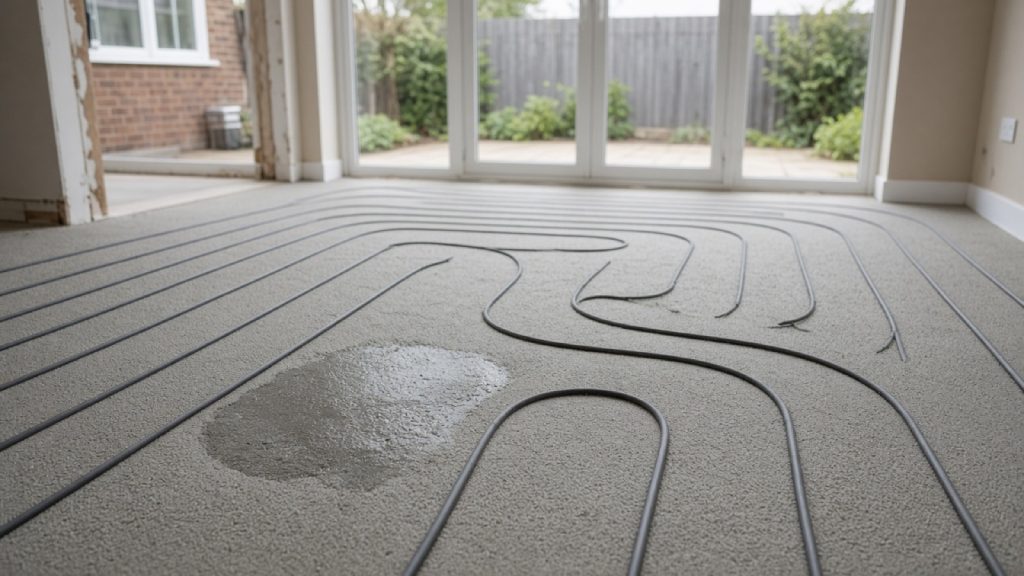
Wet underfloor heating runs plastic pipe in loops through the screed, each loop fed from a manifold. The pipe itself rarely fails. What fails is where it was damaged: a screw through it when a door frame went in, or a crack where the screed has moved.
The signs of underfloor heating leak are easy to miss because the screed soaks up the water and the floor above stays warm. By the time a tile lifts or a skirting goes black, the slab has been wet for weeks and the damp may have travelled under several rooms.
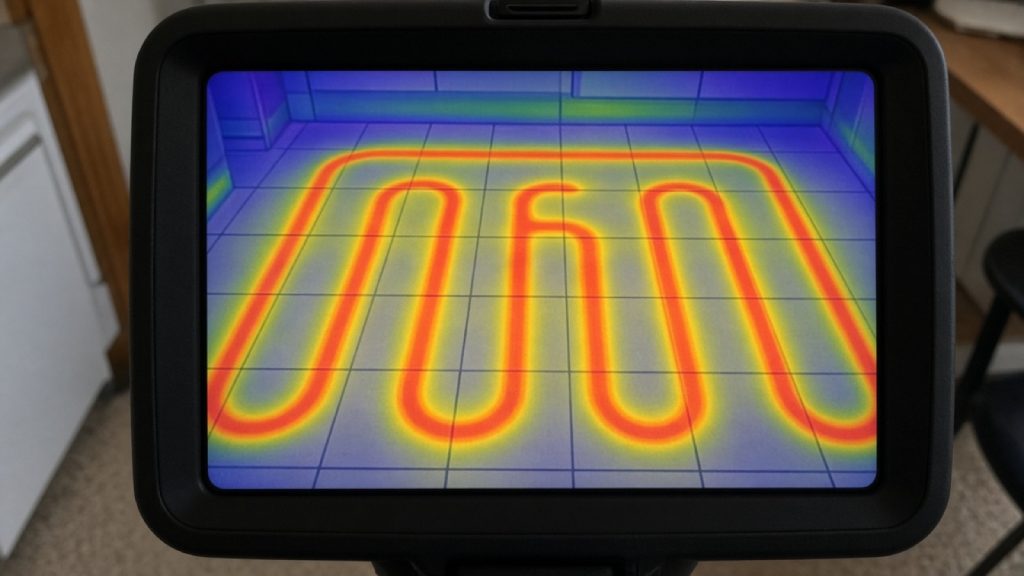
Underfloor leak detection is about narrowing the search before anything is lifted. The manifold tells us which loop is losing pressure, the thermal camera shows where that loop runs and where the heat is spreading, and tracer gas confirms the point through the screed.
The gauge falls faster when the underfloor zones are running than when only the radiators are on. That pattern points at the floor loops rather than the rest of the system.
A stretch of floor that never warms up while the rest of the room does. Water escaping from the loop stops reaching the pipe beyond the leak, so the floor past that point stays cool.
Engineered boards cupping, laminate lifting at the joints, grout turning dark or tiles sounding hollow. Moisture rising from a wet screed shows in the finish before it shows anywhere else.
Black marks on skirting, plaster blowing at floor level or a musty smell in a room with no plumbing. The screed has wicked water sideways to the walls and it is drying out there.
1
Charlie starts at the manifold: flow meters, actuators, isolation valves and the pump. Then the boiler and radiator circuit are checked, because a weeping valve or a tired expansion vessel is cheaper to find than a loop.
2
Every loop is isolated at the manifold and pressure tested on its own. The loop that loses pressure is the one with the leak. On a house with eight loops this brings the search to one room.
3
With the suspect loop running hot, the thermal camera shows its route and any warm area spreading from the pipe line. Where that is unclear, tracer gas surfaces above the hole. The spot is marked, measured and written up.
Underfloor heating is the ideal subject for an infrared camera. The loops appear as warm lines through the floor finish, and a leak shows as a warm patch spreading between them where water has soaked the screed.
A test gauge on each isolated loop at the manifold shows which loop is losing pressure and how fast. It is the step that turns a whole house into one room, done before any camera comes out.
The leaking loop is drained and charged with a hydrogen and nitrogen mix. The gas escapes at the hole and rises through the screed, adhesive and tiles or boards, and the detector reads it above the leak.
A moisture meter reads the water content of the screed and the floor finish across the room. The map shows how far the water has spread, which the insurer needs for the drying and reinstatement claim.
A new build on a Peterborough estate was losing pressure within days of each top up. At the manifold one loop dropped while the others held, the thermal camera showed where that loop ran under the kitchen floor, and tracer gas peaked beside a door frame where a fixing had gone through the pipe. The tiler lifted two tiles. In Cambourne a kitchen extension had a skirting board going black; the loop had been damaged where the screed cracked over a movement joint. In Martlesham a bungalow's bathroom floor was always warm with the heating off, which turned out to be a loop leaking hot water into the screed from a joint buried under the shower tray.
We cover Suffolk, Cambridgeshire, Essex and Norfolk from our Suffolk base, and take underfloor heating jobs in Hertfordshire, Bedfordshire, Buckinghamshire and Greater London by arrangement. Tell us how many loops are on the manifold when you call; the survey is usually booked within 24 to 48 hours.
Short, practical reads written for the problem you have in front of you.
Finding a leak in a screeded floor and putting the floor back is what trace and access cover was written for. The insurer wants to know which loop failed, how it was found and how far the water spread. The report gives the loop tests, thermal images, the marked point and the moisture map.
Call 07897 020 680 to book the survey, usually within 24 to 48 hours, and we will say what to switch on beforehand.
Landline 01440 840 772. Email hello@completeleakdetection.co.uk.