
Something is wrong and you cannot see what. The bill has jumped, the boiler keeps needing a top up, there is a smell in one room, or a patch of paint has started to bubble. You want to know how to detect a water leak before you ring anyone, and whether it is something you can deal with yourself.
This is the checklist we would work through at your house, in the order that gives the most information for the least effort. It starts with two readings that tell you which system is losing water, then goes room by room through the signs, what each one points to, and the point at which looking stops being useful and detection equipment takes over.
Start at the water meter
The meter is the most useful tool you have, because it answers the first question: is water leaving the cold mains without being used. Turn off every tap and appliance, make sure nobody flushes a toilet, and photograph the meter dial including the small wheel or red digits. Wait 20 minutes and photograph it again.
If the reading has moved, water is escaping somewhere on the mains side: the supply pipe under the garden, or a cold pipe inside the house. Repeat the test with the internal stop tap closed. If the meter now stops, the leak is inside. If it keeps turning, it is on the pipe between the meter and the house. If the meter was still both times, the mains is not the problem and you can move on.
Then the boiler pressure gauge
The central heating is a sealed loop, so a leak on it does not show on the water meter. It shows on the pressure gauge on the front of the boiler. Note the reading in the morning before the heating comes on and again in the evening. If the pressure falls and you have to keep topping it up with the filling loop, the heating circuit is losing water.
Check the obvious first: every radiator valve, every bleed valve, the pipes under the boiler and the condensate and discharge pipes outside. If they are all dry and the pressure still drops, the leak is on a pipe you cannot see, most often under a ground floor. That is one of the clearest signs of a water leak there is, and it is almost always detection work.
Signs of a water leak you can see, hear and smell
Not every leak announces itself with a puddle. Most hidden leaks show up as something slightly wrong that you notice over weeks. Paint that bubbles or flakes low on a wall. A dark tide mark along a skirting board. Laminate that has lifted at one joint. A tile that sounds hollow. A musty smell in a room that is otherwise clean and dry, worst first thing in the morning.
Listen as well. With the house silent and every tap off, a faint hiss at the internal stop tap, a tick or trickle inside a wall, or the boiler firing when no heating or hot water is being called for are all sounds of water moving where it should not. Feel the floor too: a warm patch on a tiled or vinyl floor in a house with no underfloor heating points to a heating pipe below.
• Bubbling or flaking paint low on a wall
• Dark line along a skirting or the bottom of a door frame
• Lifted laminate, a swollen board or a hollow tile
• Musty smell in one room, worst first thing
• Hiss at the stop tap or a trickle inside a wall with everything off
• Warm patch on the floor
Kitchen and utility room
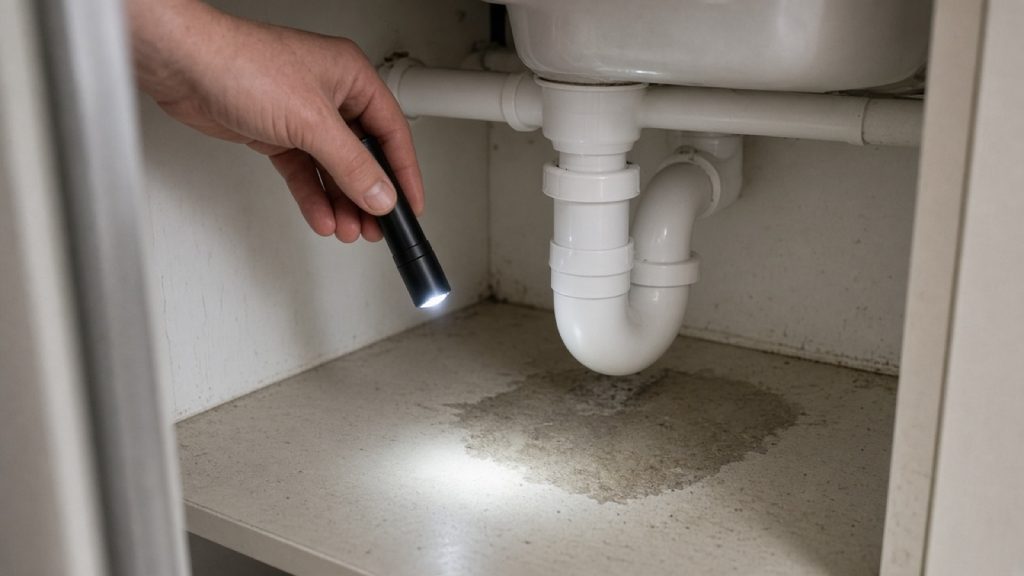
Empty the cupboard under the sink and look at the base with a torch. Swelling, a soft board or a tide mark means water has been there even if it is dry now. Run the taps and watch the trap, the flexible hoses and the isolation valves. Pull the dishwasher and washing machine forward if you can and check the hoses and the floor behind them.
The kitchen is also where the supply pipe usually enters the house and where the internal stop tap lives. Damp on the floor or wall around the stop tap, with nothing dripping, can be the supply pipe leaking just before it comes through the floor. If the fridge has a water dispenser, check the small plastic line behind it, which splits more often than people expect.
Bathroom and en suite
Bathroom leaks are different because most only run when a fitting is used. The meter and the boiler gauge stay still, and the sign is a stain on the ceiling below that comes and goes. Start with the seals: run a finger along the silicone where the bath and shower tray meet the wall and look for gaps, black mould or a bead that has pulled away. Check grout for cracks, especially in the corners and along the bottom row.
Take the bath panel off and run the bath, then the shower, then the basin, watching the waste connections and the trap each time. Look at the toilet pan connector at the back and the base of the pan for staining. Then look inside the cistern for a trickle running into the pan, which is a silent leak that goes straight down the drain and only shows on the bill.
A shower valve leaking inside the wall is the one bathroom leak you will not find by looking, because the water runs down inside the stud or behind the tiles. If the ceiling below is wet only after showers and every seal and waste is sound, that is the likely cause, and it is found with a moisture meter and the thermal camera from below rather than by removing tiles.
Living rooms, hallways and bedrooms
In the rooms with no plumbing of their own, the leak is either coming through from above or rising from below. A ceiling stain maps to whatever is directly overhead: a bathroom, a hot water cylinder, a radiator or the loft tank. A patch low on a wall or along a skirting is more often a heating pipe under the floor, or in a ground floor room on an older house, a cold pipe running through the slab.
Mark the edge of any stain in pencil and date it, then check it a week later. A stain that grows is live. One that stays the same may be an old leak already fixed. On a suspended timber floor, lift a board near the damp if you can and look with a torch. On a solid floor there is nothing to lift, and that is where the thermal camera earns its place.
Outside: the garden, the drive and the stop tap
Walk the line between the meter and the house. The supply pipe usually takes the shortest route, but on older properties it can wander. Look for a strip of lawn that is greener, softer or sinks underfoot, moss in a paving joint, a damp patch on the drive that never dries, or water at the kerb in dry weather. In winter, a strip that stays frost free when the rest of the lawn is white is a strong sign.
Check the outside tap and the pipe behind it, any garden irrigation, and the feed to a garage, outbuilding or stable. Then lift the lid on the boundary stop tap chamber and look inside. Standing water in the chamber in dry weather, or a hiss from the tap, both point to the supply pipe. Remember that the pipe from the boundary to the house is yours to repair, not the water company's.
What each sign points to
Put the readings and the signs together and you can usually say which system is leaking before anyone visits. The list below is the one we run through when someone rings and describes what they have found. It is not perfect, but it decides which equipment comes to the house.
• Meter turns, stop tap closed, meter still turns: supply pipe outside
• Meter turns, stop tap closed, meter stops: cold pipe inside
• Boiler pressure drops, radiators and boiler dry: heating pipe under a floor
• Pressure drops and part of the floor is warm or cold: underfloor heating loop
• Ceiling stain under a bathroom, meter still: bathroom seal, waste or shower valve
• Stain under a bedroom or landing: radiator, cylinder or loft tank
When looking stops and detection starts
Everything above is free and takes an afternoon. It will find a visible leak and it will tell you which system a hidden one is on. What it will not do is tell you the point on a buried or boxed in pipe, and that is the only thing that matters once you know a leak exists. Breaking a floor or digging a drive on a guess is the expensive way to finish.
The tools we use to detect water leak sources behind finished surfaces are the thermal camera, which shows warm or cold water spreading under a floor or inside a wall, the ground microphone, which picks up water escaping under pressure from a buried pipe, and tracer gas, which is put into a drained circuit so a detector can follow it to the break. Together they give one marked spot and a written report.
If you have reached this point and search for water leak detection near me, you will find plumbers, call centres and specialists. Ask whoever you ring whether all three methods come on the first visit, whether the price is fixed on the phone, whether the report is included and what happens if nothing is found. We cover East Anglia and Greater London, work no find, no fee, and can usually book you in within 24 to 48 hours.