
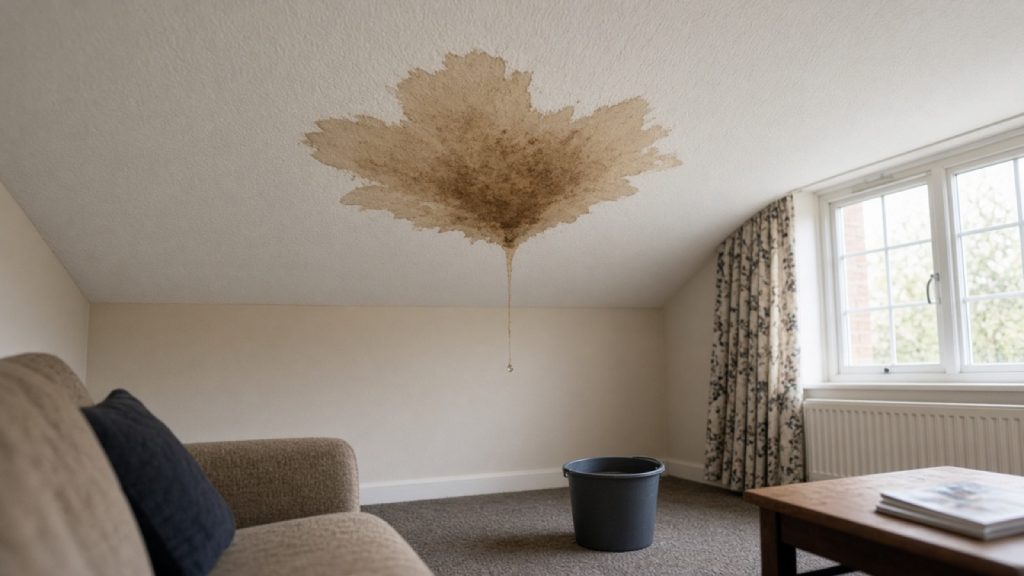
A water leak from a ceiling rarely gives much warning. One day there is a faint ring on the plaster. The next the paint is bubbling and drips are landing on the carpet. The instinct is to hunt for the cause straight away. The better order is to stop the water, protect the room and the ceiling, and only then work out where it is coming from.
This article takes you through that first hour step by step. It then explains how to tell a bathroom leak from a heating leak, a roof leak or a leak from the flat above, because each one needs a different person and a different fix. Finally it covers what happens when the cause is not obvious, and how a leak detection visit finds it without the whole ceiling coming down.
Stop the water first
If water is actively dripping, turn off the internal stopcock. It is usually under the kitchen sink. Turn it clockwise until it stops. That cuts the mains supply to the house, so a leak on a cold pipe, a toilet or a bathroom feed slows and then stops as the pipes empty.
If the drip carries on with the stopcock off, the water is coming from somewhere the stopcock does not control. The two usual answers are the central heating circuit, which holds its own water, and the stored water in a loft tank. For heating, switch the boiler off at its own switch and leave it off. For a tank, close the gate valve on the pipe leaving it if you can reach it safely, and run the hot taps to empty it.
Water and electricity meet at the ceiling. If the leak is anywhere near a light fitting, a downlight or a smoke alarm, switch that lighting circuit off at the consumer unit and leave it off until an electrician has checked it or everything has dried out. Do not use the light switch in that room to test it.
• Stopcock off: usually under the kitchen sink, clockwise to close
• Still dripping: switch the boiler off, check for a loft tank
• Water near lights: that circuit off at the consumer unit
• Move furniture, rugs and electricals out from under the stain
• Put a bucket and an old towel under the lowest point
Drain a bulging ceiling before it drains itself
Plasterboard holds a surprising amount of water before it fails. If the ceiling is sagging or you can see a bulge, water is pooling on top of the board and it will come down in one go, bringing the board with it. Put a bucket underneath, stand to one side and push a screwdriver or a skewer through the lowest point of the bulge. The water runs out in a controlled stream and the board usually survives.
If the bulge is large, make two or three holes along its lowest line rather than one, and swap buckets as they fill. If the ceiling is lath and plaster, which is common in Victorian and Edwardian houses across East Anglia and London, keep people and pets out of the room, because old plaster is heavy and comes down in slabs.
Photograph everything before you clean up
Before you mop, take photographs: the stain, the drips, the bucket, the damaged flooring and anything else that got wet. Photograph the boiler pressure gauge and the water meter reading too. These are the evidence your insurer will ask for, and they cannot be recreated once things have dried.
Write down the time you noticed the leak, the time you turned the water off and who you called. Keep receipts for emergency help, dehumidifier hire or materials. Most home policies cover damage from an escape of water, and most include trace and access cover for the cost of finding the leak, but both rely on you showing what happened. Ring your insurer early, before any repair, so the claim is open.
Is it the bathroom, the heating, the roof or the flat above
The pattern of the leak tells you more than the stain does. Think about what sits above the wet patch and when the water appears. A water leak in a ceiling under a bathroom that only shows after someone has showered is a bathroom leak. A leak that drips steadily day and night, whether anyone is home or not, is a pressurised pipe: either the mains or the heating. A leak that only appears when it rains is the roof, a gutter, a flashing or a window above.
The stopcock test helps here. If closing the stopcock stops the drip within a few minutes, the leak is on the mains side: a cold feed, a toilet cistern, a tap connection. If the boiler pressure gauge has dropped and keeps dropping, the heating is losing water, and the pipe may be in the ceiling void or under the floor above. If neither the stopcock nor the boiler make any difference, look at the roof, the bath and shower seals, and the people upstairs.
• Appears after a shower or bath: bathroom seal, tray, waste or valve
• Drips day and night and the stopcock stops it: mains pipe or fitting
• Boiler pressure falling: heating pipe in the floor or ceiling void
• Only when it rains: roof, gutter, flashing or window
• You live in a flat: the flat above, or a shared riser
Bathroom leaks: the first place to look
Most water leaks through a ceiling under a bathroom come from something that only leaks when it is used. A failed silicone seal around the bath or shower tray lets a little water behind the panel every time someone showers. A cracked grout line does the same behind the tiles. A loose waste under the bath, a shower valve weeping inside the wall or a toilet pan connector at the back of the pan all leak into the floor void and show up below.
You can test some of this yourself. Fill the bath, let it stand for half an hour, then pull the plug and watch the ceiling below. Run the shower for ten minutes with the door open and then closed. Flush the toilet several times. If one of these brings the drip on, you have narrowed it to that fitting, which is useful to whoever comes to fix it.
The hard cases are the ones where every fitting seems fine but the stain keeps growing. Water travels along joists and pipe runs before it drops, so the wet patch can be a metre or more from the fitting that caused it. That is where a moisture meter and a thermal camera earn their keep.
Heating pipes in the ceiling void
Where the heating pipes run through the floor above, a pinhole in a copper pipe or a weeping joint drips into the ceiling below. The clue is the boiler. If the pressure gauge has crept down and you have been topping it up, the system is losing water somewhere, and a stain under a bedroom or a landing is a strong hint as to where. Heating water also tends to leave a brown or orange mark rather than a clean wet one, because of the rust it carries.
Stop topping up. Every fill is fresh water into the ceiling. Turn the heating off, note the pressure and ring for help. With the circuit still warm, a thermal camera shows the pipe runs through the ceiling and the wider warm patch where water has spread, and tracer gas confirms the exact point. One section of board comes down, not the whole ceiling.
Leaks from the flat above
In a flat, the source may not be yours at all. Knock on the door above and ask whether they have had a problem: an overflowing bath, a washing machine hose, a dishwasher. Communal risers and shared heating mains sit between flats and are usually the landlord's or the management company's responsibility. A written report that states where the leak was found and which pipe failed stops the argument about whose problem it is, which is often the part that drags on longest.
Finding the water leak from the ceiling when nothing is obvious
When you have done the tests above and still do not know, the answer is to locate the leak rather than open the ceiling to look for it. A leak detection visit works from the outside in. We start with the readings: the meter with everything off, the boiler pressure, and the pattern you have noticed. That decides which pipework is losing water before any equipment comes out.
Then the equipment narrows it to a point. A thermal camera picks up the temperature difference where water has spread through the board and along the joists, and shows warm heating pipes through the plaster. A moisture meter maps how far the wet has travelled and which direction it came from. For a heating circuit, tracer gas pushed through the pipes rises through the ceiling directly over the break.
The result is a marked spot and a written report with photographs and readings, suitable for a trace and access claim. The repairing plumber opens that spot only. We work no find, no fee, and we can usually book you in within 24 to 48 hours.
What to do next
Keep the water off until the leak is found or fixed. Keep the room ventilated and the furniture out. Keep the photographs and notes together. If the cause showed itself in the tests above, a plumber or roofer can fix it directly. If it did not, ring us on 07897 020 680 at any time, or 01440 840 772 in office hours, and tell us what the stopcock test and the boiler gauge showed. That tells Charlie which kit to bring.