
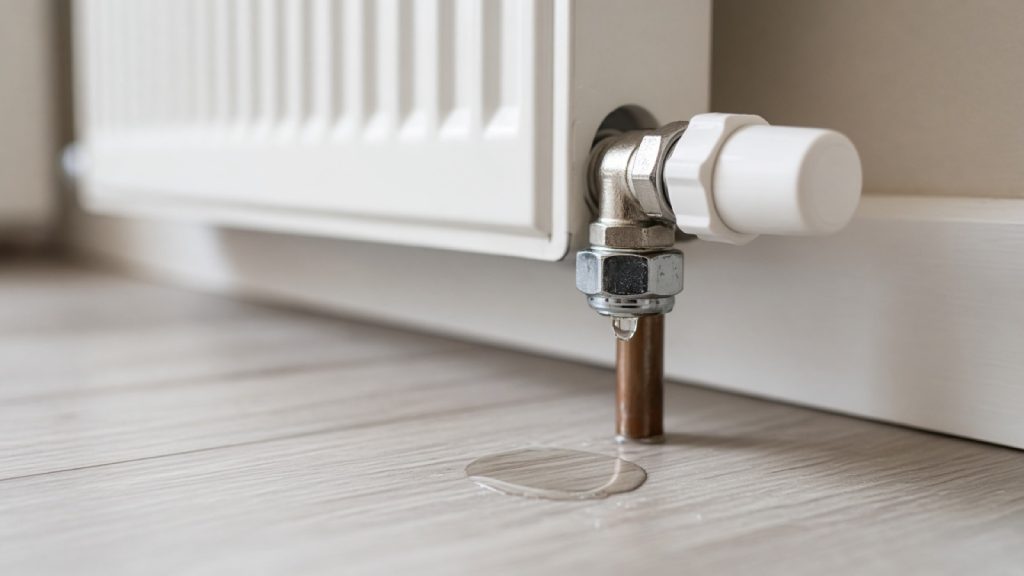
A leaking radiator usually announces itself as a small puddle under one end, a rusty tide mark on the carpet, or a drip you can hear at night when the heating is on. It is a common heating fault, and most of the time it is a cheap fix. The trick is working out which part is leaking, because they all look the same from the sofa.
This article walks round a radiator part by part: the valves, the spindle, the bleed valve, the tails, the pipe joints and the panel itself. It explains what each leak looks like, what you can do tonight to limit the mess, and what a plumber will do to fix it. It then covers the case that catches people out: every radiator is dry, but the boiler pressure keeps falling.
First, find exactly where the water starts
Dry everything with kitchen roll, then wrap a single sheet of dry paper round each part in turn and wait a minute. The first sheet to spot tells you where the water starts. Water runs downhill along the pipe and the valve body, so a drip at floor level often starts at the spindle or the tail above it. Do the check with the heating on and the system warm, because some joints only weep under pressure.
Look for the pattern as well as the place. A dry white or green crust on a brass fitting is an old slow weep that has been evaporating as fast as it leaks. A rust streak down the face of a panel points to the panel itself. A pool that appears only after the radiator has been bled is the bleed valve. Note what you find before you ring anyone, because it decides whether this is a ten minute job or a drain down.
A leaking radiator valve
The valves are the two brass fittings at the bottom corners. One is the control valve, with a wheel head or a thermostatic head, and the other is the lockshield under a plastic cap. A leaking radiator valve almost always leaks from one of three places: the gland nut under the head where the spindle passes through, the union nut that joins the valve to the radiator tail, or the compression nut that joins it to the pipe below.
A weep from the gland nut is the commonest, and the easiest. Behind the nut is a packing that seals the spindle, and it dries and shrinks over the years. A plumber tightens the gland nut a fraction, or repacks it with PTFE tape wound round the spindle. On a thermostatic valve the head comes off first, and the pin underneath sometimes needs freeing as well.
The union and compression nuts are a different job. They need the radiator isolated or the system drained to a point, then the olive or the joint remade. Overtightening a weeping compression nut with a spanner usually makes it worse by crushing the olive, so leave that one to the plumber.
The spindle and the bleed valve
If the leak comes from the top of the valve body right where the spindle enters, under the plastic head, it is the spindle seal. It often starts after someone has turned the valve for the first time in years, because the packing has stuck to the spindle and torn. Closing the valve fully sometimes stops it for the night, because the spindle is pressed down onto its seat.
The bleed valve is the small square-headed screw at the top corner. It leaks for two reasons: it was not closed fully after bleeding, or the tiny seal inside has worn. Close it gently with a radiator key. If it still weeps, a plumber fits a new bleed valve in minutes with the radiator isolated. Never force it, because the brass thread strips easily.
A leaking radiator pipe or tail
The tails are the short threaded pieces that screw into the radiator and take the valves. They are sealed with PTFE tape or paste on the thread, and after a few decades of heating up and cooling down the seal fails. The leak shows as a weep at the junction between the valve and the radiator, with the valve itself dry. Fixing it means draining the radiator, taking the valve off and re-sealing the tail.
A leaking radiator pipe is usually a joint rather than the pipe. Look at the elbow just below the valve, and at any joint you can see under the floorboards or behind the skirting. A pinhole in the copper itself does happen, especially where the pipe has been sitting in a damp screed, and that is a cut and a new section rather than a tightened nut.
The radiator panel can also go. Sludge and rust inside the system eat the steel from the inside out, and a pinhole shows as a rusty bead on the face or the bottom seam. Nothing seals that properly. The radiator is replaced, and it is worth asking the plumber to flush the system and add inhibitor so the next one lasts.
What to do tonight
Closing both valves cuts that radiator off from the rest of the system. The control valve turns clockwise by hand. The lockshield needs a spanner or pliers on the spindle under its cap, and it also closes clockwise. Count the turns as you close it so the plumber can set it back to the same place, because that setting balances the system. The water left inside still drips out, but it stops once the radiator has emptied down to the level of the leak.
• Close both valves at that radiator so it is isolated
• Put a towel and a flat tray under the drip, not a bowl that tips
• Turn the heating off if the drip is fast
• Note the boiler pressure now and again in the morning
• Do not keep topping the boiler up overnight
Can a leaking radiator cause boiler pressure to drop
Yes. A sealed system, which is what nearly every combi and system boiler runs, holds a fixed amount of water under pressure. Any water that leaves it, from a weep at a gland nut to a pinhole in a panel, lowers the reading on the gauge. A slow weep might take weeks to show. A steady drip can take the pressure from the normal band to zero overnight, and the boiler then locks out until it is topped up.
So the gauge is a useful check. If you fix the leaking radiator and the pressure then holds steady for a week or two, that was the whole problem. If it keeps falling with every radiator, valve and visible pipe dry, the system is still losing water somewhere you cannot see, and that is a different job.
Is a leaking radiator an emergency
Rarely. A weep at a valve or a bleed screw is an inconvenience and a stain, not a flood, and it waits for a plumber in normal hours with the radiator isolated. It becomes urgent in three situations: the drip is fast enough to fill a bowl in an hour, the radiator sits above a ceiling that is now showing a wet patch, or the water is running towards a socket or an appliance. In those cases isolate the radiator, turn the heating off and ring someone the same day.
The other time to move quickly is when the boiler keeps losing pressure and you cannot find a wet radiator. Every top up is fresh water going into a floor or a wall, and the longer that runs the more there is to dry out and put right afterwards.
The radiators are dry but the pressure still drops
This is where it stops being a radiator job. If every radiator, valve and visible pipe is dry, and the boiler itself is dry underneath, the circuit is losing water on a run you cannot see: under a ground floor, in a screed, in a wall or in a ceiling void. In houses built from the 1950s to the 1980s the pipes were often laid in the concrete floor, and they corrode from the outside. A plumber cannot fix what cannot be seen, so the next step is to find it rather than to lift boards on a guess.
That is detection work. We pressure test the circuit to confirm it is losing water, then use a thermal camera with the heating warm to see the pipe runs and the warm patch where water is spreading. Tracer gas through the circuit gives the exact point. The floor is opened at one marked spot, you get a written report for a trace and access claim, and we work no find, no fee. Ring 07897 020 680 and tell us what the gauge has been doing and how often you have topped up. We can usually book you in within 24 to 48 hours.