
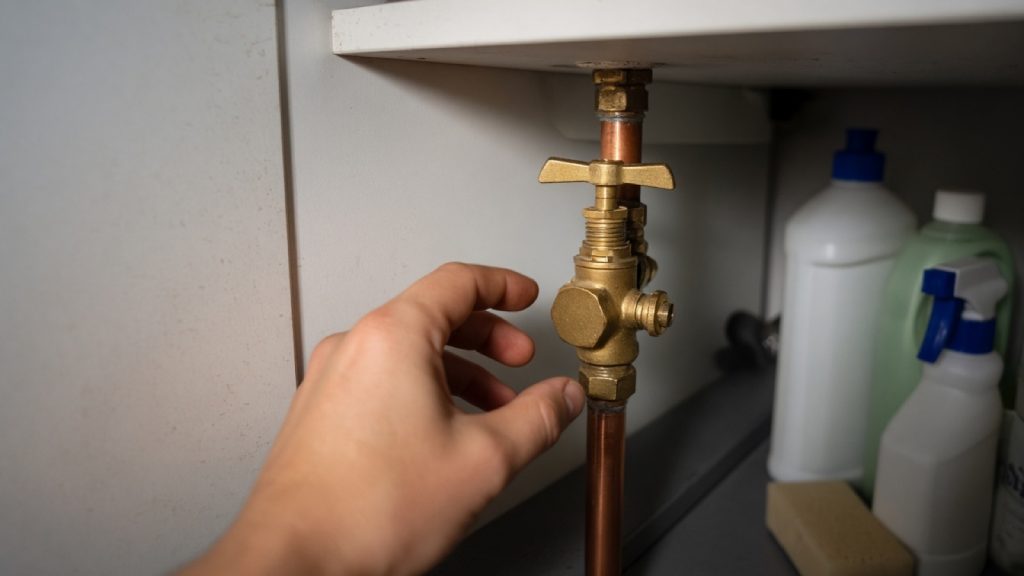
Where is my stopcock is the question people ask with water already on the floor, and that is a bad time to be searching. Every house has one somewhere on the pipe where the mains comes in, and finding it now, before you need it, is the most useful ten minutes of leak preparation you can do.
This article explains where to look inside the house and outside at the boundary, what a stopcock looks like in older and newer homes, how to turn it without breaking it, and what to do when it has seized. It also covers the case that worries people most: the stopcock is off and water is still running, and what that tells you about where the leak is.
Where to look inside the house
The internal stopcock sits where the mains supply pipe enters the building, and in most houses that is the kitchen, because the kitchen cold tap is the one fed straight from the mains. Open the cupboard under the sink and look at the back, low down, for a brass fitting on the pipe coming up through the floor or in through the wall. It may be behind the bin, the cleaning products or a removable panel.
If it is not there, work along the wall the supply would come from. Common second homes are under the stairs, in a downstairs toilet, in a utility room, in the garage, in a larder or in a cupboard by the front door. In older terraced houses it is sometimes in the cellar or under a floorboard just inside the front door. In flats it is often in the hallway cupboard with the meter, behind the bath panel, or in a communal riser cupboard on the landing.
• Under the kitchen sink, low at the back
• Under the stairs or in the downstairs toilet
• Utility room, garage or larder
• Cupboard by the front door, or under a board just inside it
• Flats: hallway cupboard, bath panel or the landing riser
What does a stopcock look like
In most homes the stopcock is a brass fitting about the size of a fist, with a round wheel head on top like an outside tap, fitted in line on a copper or lead pipe. It is often painted over, dusty or green with age. Newer houses and recent replumbing use a lever valve instead: a brass or chrome body with a flat handle that sits along the pipe when open and across it when closed. Some have a blue handle to mark it as cold water.
Do not confuse it with a gate valve, which has a wheel head too but a wedge-shaped body, and which controls stored water from a tank rather than the mains. Do not confuse it with an isolation valve, the small screwdriver-slot valve on the pipe to a single tap or toilet. Those isolate one fitting. The stopcock isolates the whole house.
The outside stop valve at the boundary
There is a second valve outside, on the water company's side of the supply. Look in the pavement or the verge in front of the house, or just inside the front boundary, for a small square or round cover, often marked with a W, the word Water or the company's name. Under it, in a pipe sleeve, is the outside stop valve, usually with the meter alongside in a metered house. It can be a foot or more down.
Turning it needs a stopcock key, a long T-shaped bar from any DIY shop, because you cannot reach it by hand. Some older ones take a crutch head, some a square key. If you have a meter, the meter chamber often has a small lever valve you can reach. Clear the mud and gravel out of the chamber first so you can see what you are dealing with.
How to turn a stopcock off and on
Clockwise closes it. Turn it gently as far as it will go and no further: it is a tap, not a bolt, and leaning on it with a wrench shears the spindle or cracks the body. Then open the kitchen cold tap. The flow should drop to a dribble and stop within a minute as the pipe empties. Hot taps and the bathroom cold tap may keep running for a while if there is a tank in the loft, because that is stored water, not mains.
When you open it again, turn it anticlockwise fully, then back a quarter turn. Leaving it a quarter off the end stop makes it less likely to jam open next time. Turn it off and on twice a year, in the same spirit as testing a smoke alarm, so it stays free. That habit is what separates a stopcock that works in an emergency from one that does not.
Stopcock seized: what to do and what not to do
A stopcock that has not moved in twenty years often will not move now. Do not reach for a wrench and force it. The spindle snaps, the packing tears and you have turned a dry problem into a wet one. Spray penetrating oil round the spindle and the gland nut, leave it an hour, and try again with a firm hand, working it back and forth a few degrees at a time rather than going for a full turn.
If it still will not shift, use the outside stop valve to shut the house off, then have a plumber replace the internal stopcock with a lever valve. It is a short job with the mains off and it is worth doing before you need it. If the stopcock has seized during a leak and you cannot get to the outside valve either, ring your water company's emergency line and tell them you cannot isolate the property.
Stopcock turned off but water still running
This is the one that frightens people, and it has four ordinary explanations. The first is that the stopcock is worn and letting water past, which is common on old wheel-head valves: the flow drops but does not stop. The second is stored water. Hot taps, the bathroom cold tap and the toilet cistern are often fed from a tank in the loft, and they keep running until the tank empties. The third is the central heating, which holds its own water and is not affected by the stopcock at all.
The fourth is the useful one. If you have turned the stopcock off and the leak carries on at the same rate, the water is getting out before it reaches the stopcock. That means the supply pipe between the boundary and the house, which usually runs under the front garden, the drive or the kitchen floor. Turn the outside stop valve off as well. If the leak now stops, you have proved it: the leak is on the supply pipe, and that is a buried pipe to find rather than a fitting to tighten.
Who is responsible for the outside stopcock
The water company owns and maintains the outside stop valve at the boundary and the pipe from there back to the main in the road. Everything on your side of that valve is yours to maintain: the supply pipe under the garden, all the pipework inside and the internal stopcock. If the outside valve is broken, buried or missing, report it to the company and they should repair or replace it. If the leak is on your supply pipe, the repair is yours, although most companies run a leak allowance scheme and some offer help with the repair, so it is always worth asking.
Where there is doubt about which side of the boundary the leak sits, the meter settles it. A leak that shows on the meter with everything off is on your side. A wet patch in the pavement with a still meter is probably theirs. Our article on what to do when Anglian Water says you have a leak goes through that conversation in detail.
What the stopcock test tells you about the leak
Put together, the checks above sort a leak into one of three places before anyone lifts a floorboard. Stopcock off stops it: the leak is on the mains pipework inside the house, often a pipe under a floor or in a wall. Stopcock off does nothing but the outside valve stops it: the leak is on the buried supply pipe. Neither makes any difference and the boiler pressure is dropping: the leak is on the heating circuit.
Each of those is found differently. A supply pipe under the drive is traced and then listened to with acoustic equipment, with the ground opened at one spot. A pipe inside the house is narrowed down with a thermal camera and moisture readings. A heating circuit is pressure tested and traced with gas. Tell us which valve did what when you ring 07897 020 680 and we can usually book you in within 24 to 48 hours. We work no find, no fee and leave you a written report for your insurer.