1
Work out whose problem it is
In a house, a meter test and a pressure test tell Charlie whether the mains or the heating is losing water. In a flat, he isolates each supply and watches which meter moves.

Leak detection in Borehamwood
Borehamwood doubled in size after the war and its houses and blocks share a lot of concrete floor. Charlie traces leaks through it without lifting it.
Only pay when found
Flats and shared pipes
Insurance report included
Tell us what you have noticed and where. We ring you back to talk it through. No find, no fee.
No find, no fee
24/7 enquiries
Non-invasive methods
Reports for insurance claims
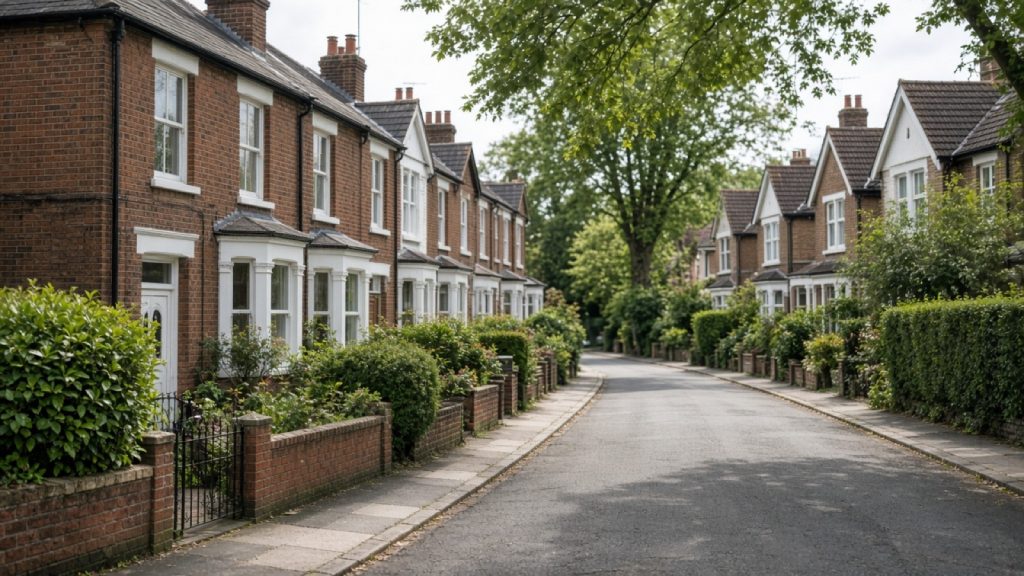
Most of Borehamwood was built in the 1950s and 1960s as London overspill, in long runs of terraces and semis on solid floors, with later blocks of flats along Shenley Road and around the station. That gives Borehamwood leak detection a particular character: heating pipes in screed, and in the flats, pipework that serves more than one home.
Affinity Water supplies the town, and for a flat the first job is working out which supply and which heating circuit the loss belongs to. Charlie covers Borehamwood and Brookmeadow regularly, so water leak detection Borehamwood residents book is not a trip into the unknown.
1
In a house, a meter test and a pressure test tell Charlie whether the mains or the heating is losing water. In a flat, he isolates each supply and watches which meter moves.
2
The thermal camera reads the solid floors of a Borehamwood terrace well. Heating runs show as warm lines through the screed, and a leak as a wider warm or wet spread.
3
Acoustic listening or tracer gas narrows the fault to a hand span. We mark it, photograph it and note the readings, so the report shows the insurer what was found.
Concrete floors and plastered party walls are what the camera does best. It shows the heating layout of a 1960s terrace in a minute, and reads a damp ceiling in a flat.
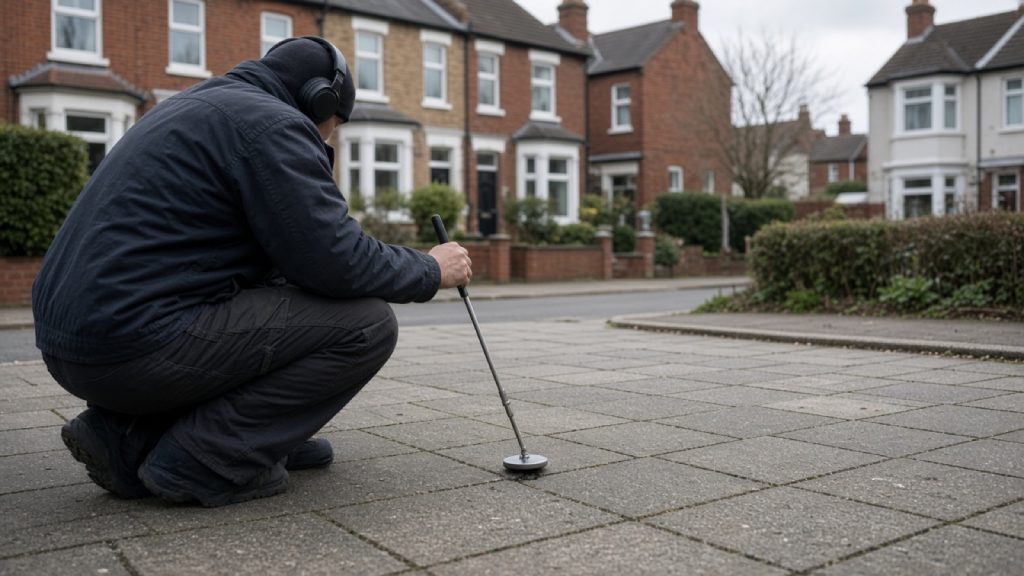
A supply pipe under a Borehamwood front path or a shared forecourt is traced from the surface with a ground microphone. The hiss peaks over the break, and the repair lifts a slab or two.
Where a heating pipe sits deep in screed, or a riser in a block is boxed in, we drain the circuit and introduce a hydrogen and nitrogen mix. It escapes at the leak and is detected at the surface.
In a block of flats on Shenley Road water was showing on a bedroom ceiling and two flats above were blaming each other. We isolated each supply and heating circuit in turn and watched the meters, which showed the loss belonged to the shared riser rather than either flat, and the report said so for both insurers. On one of the 1960s terraces at Brookmeadow a boiler had been losing pressure; thermal imaging showed the heating pipe in the screed and tracer gas marked the failure under the hall. A semi near the station had a meter turning with the house shut off, and the ground microphone traced the supply pipe under the drive to a split by the door.
Radlett is next door across Watling Street and Potters Bar is a short run east. Bushey and Watford lie to the west, and St Albans and London Colney are up the A1(M), all on the leak detection Hertfordshire round.
In a flat the report has a second job: it tells the managing agent and the neighbour's insurer whose pipe failed. We record the isolation tests, the meter movements, thermal images and photographs, and mark the position on a plan. For a house it does the same for the supply pipe or heating circuit.
Dial 07897 020 680. Say if it is a house or a flat.
Landline 01440 840 772. Email hello@completeleakdetection.co.uk.