The pipe is in concrete
Ground floor slabs, screeded floors, garage floors and commercial units. Sound does not travel well through concrete and a slow leak gives little heat, but hydrogen comes up through the slab and the joints.

Tracer gas leak detection across East Anglia
When a pipe is buried in concrete or deep underground, sound and heat run out. Charlie fills the pipe with a safe hydrogen mix, follows it to the surface and marks the leak, from Hertford to the Norfolk coast.
Works through concrete and tarmac
Hydrogen and nitrogen mix
Marked to the centimetre
No find, no fee
Tell us what you have noticed and where. We ring you back to talk it through. No find, no fee.
No find, no fee
24/7 enquiries
Non-invasive methods
Reports for insurance claims
Tracer gas leak detection is the method for leaks other methods cannot reach. A pipe in a concrete slab, a supply pipe a metre down under a drive, a plastic heating loop in screed: none of these give a clear sound or a clear heat signature. All of them let gas through.
The gas is a mix of 5 percent hydrogen and 95 percent nitrogen. It is non toxic and non flammable at that ratio, and it leaves nothing behind in the pipe. Hydrogen is the smallest molecule there is, so it escapes through a split that sound cannot get out of, and rises straight up.
We offer tracer leak detection in Hertford, Welwyn Garden City and across Hertfordshire, as well as throughout Suffolk, Norfolk, Cambridgeshire, Essex, Bedfordshire, Buckinghamshire and Greater London. Charlie carries the tracer gas leak detection equipment on every job, whatever the first method.
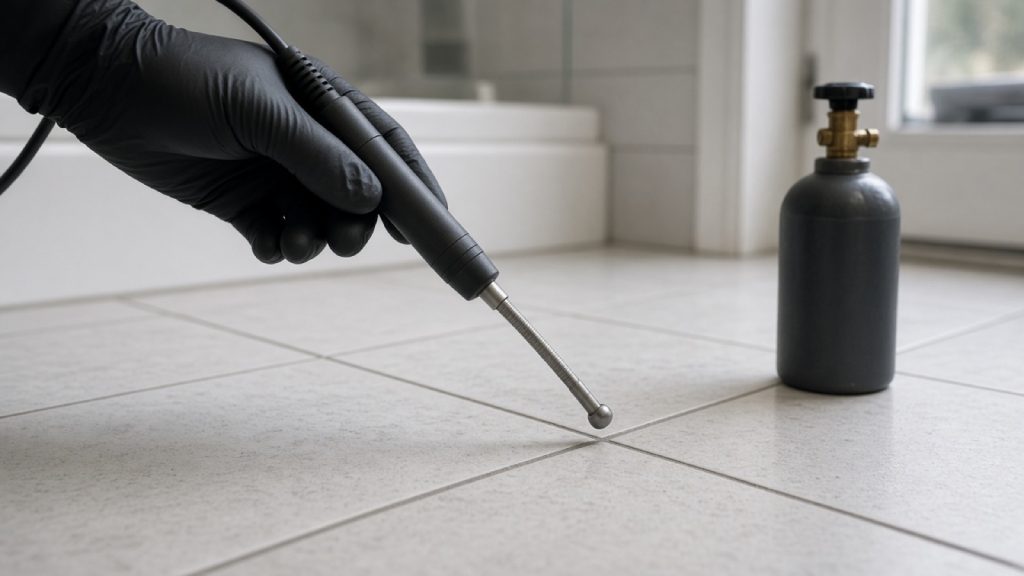
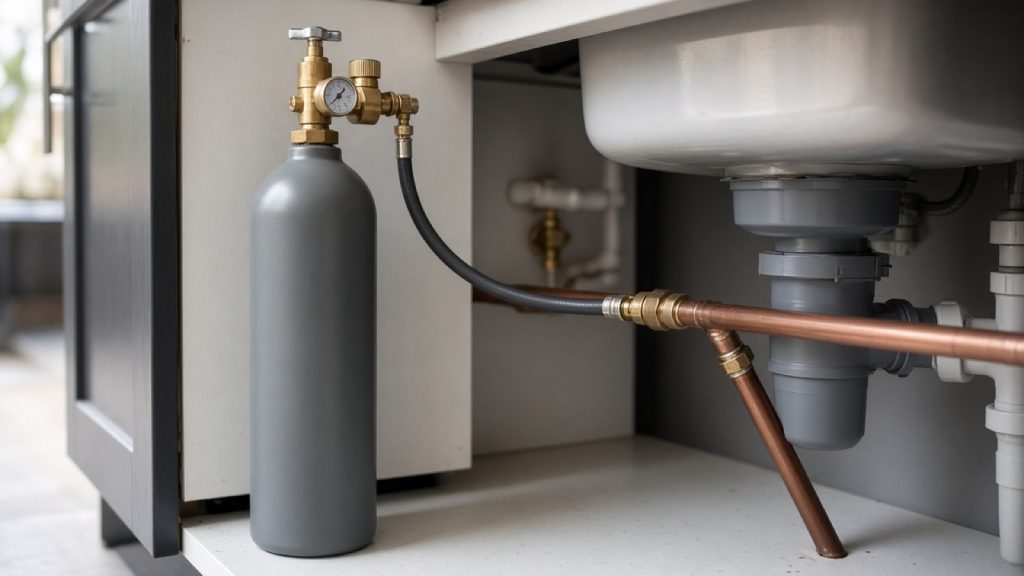
Ground floor slabs, screeded floors, garage floors and commercial units. Sound does not travel well through concrete and a slow leak gives little heat, but hydrogen comes up through the slab and the joints.
Plastic pipe carries almost no sound, and a pipe a metre down in soft ground loses what little there is. Tracer gas is not limited by depth or pipe material.
If an acoustic or thermal survey has failed to find the leak, or found three possible spots, a gas test resolves it. The gas only surfaces where it escapes, so there is one answer.
A heating system losing pressure over a week, or a meter creeping at a few litres an hour, is a pinhole. Pinholes are near silent and barely warm, and hydrogen still gets out of them.
1
The pipe or heating loop is isolated at both ends and drained, so the gas fills the pipe rather than bubbling through water. The hydrogen and nitrogen mix is then connected and brought up to working pressure.
2
Charlie walks the pipe route with a hand held hydrogen detector, sampling at the surface every few centimetres. The reading climbs as the detector approaches the leak and peaks directly above it. Cracks and joints are checked closely.
3
The peak reading point is marked on the floor or ground and measured from fixed points. The report gives the pressure readings, the route and the marked position with photographs, so the repair opens one small area.
A cylinder of 5 percent hydrogen in nitrogen with a regulator and test connections for copper, plastic and barrier pipe. The detector reads in parts per million, so it registers gas surfacing from a pinhole a metre below.
Used alongside the gas on supply pipes and metal pipework. Where the ground is firm and the pipe is metal, a ground microphone often confirms the gas reading from a second direction, for a tighter mark.
Used first on heating pipes and underfloor heating. The camera shows the pipe route and any warm spread, which tells us where to concentrate the gas scan. On a cold supply pipe the gas does the work.
Every tracer gas survey starts with a pressure test on the isolated pipe. A pipe that holds pressure does not need gas. A pipe that drops gets the gas, and the rate of drop says how much to expect.
A 1930s house in Hertford had a supply pipe a metre down under a long block paved drive, and the listening equipment gave nothing through the depth. Charged with the hydrogen mix, the pipe gave the leak away through a joint in the paving halfway up, and one small section was lifted. On the north Norfolk coast a holiday bungalow had a private supply running across a paddock; tracer gas found a split in the plastic pipe that no sound had come from. In a Canary Wharf apartment the heating loop in the screed was losing pressure, and the detector peaked beside the balcony door where the pipe had been nicked on installation.
We work from our base in Suffolk and cover Hertfordshire, Cambridgeshire, Essex, Norfolk, Suffolk, Bedfordshire, Buckinghamshire and Greater London. Hertford, Ware and Welwyn Garden City are just over an hour away, and most tracer gas visits are booked within 24 to 48 hours.
Short, practical reads written for the problem you have in front of you.
A tracer gas survey produces the kind of evidence a claims handler likes: a pressure test showing the loss, a marked and measured leak point, and photographs of the detector reading above it. The report sets this out in plain language with the route and the method for the trace and access claim.
Call 07897 020 680 and tell us what has already been tried; a tracer gas visit can usually be booked within 24 to 48 hours.
Landline 01440 840 772. Email hello@completeleakdetection.co.uk.