A water bill that jumped
Anglian Water estimates some bills, so a leak can hide for months. If the first metered reading is far higher than usual, read the meter again with every tap off.

Leak detection in Suffolk
Charlie covers the whole county, from leak detection in Kesgrave and Ipswich to the Brecks around Brandon and the Waveney towns in the north east. One engineer, non-invasive equipment, and a report your insurer can use.
No find, no fee
Booked within 24 to 48 hours
Based in Haverhill
Written reports for insurers
Tell us what you have noticed and where. We ring you back to talk it through. No find, no fee.
No find, no fee
24/7 enquiries
Non-invasive methods
Reports for insurance claims
Complete Leak Detection is based in Haverhill, on the Suffolk side of the border with Essex and Cambridgeshire. That puts Bury St Edmunds and Newmarket within half an hour, Stowmarket and Ipswich under an hour, and the coast a straight run down the A14 or A12.
Suffolk is a county of long supply pipes. Outside the towns, many homes sit at the end of a private pipe that runs from the Anglian Water stop tap at the road, under a drive or a paddock, into the house. When those pipes fail you rarely see water. You see a high bill or a meter that keeps turning.
In the towns the problems differ. Ipswich and Lowestoft have Victorian terraces with pipework altered many times. Bury St Edmunds, Lavenham and Long Melford have timber-framed buildings where a leak travels a long way before it shows. Newer estates round Stowmarket and Kesgrave bring underfloor heating and plastic manifolds.

Anglian Water estimates some bills, so a leak can hide for months. If the first metered reading is far higher than usual, read the meter again with every tap off.
If you top up a sealed heating system every few days and no radiator drips, the water is going somewhere. Often it is a pipe under a solid floor.
A patch low on a wall, a lifting floor, or a musty smell in one room with no roof fault above it usually points to a pipe hidden behind lath and plaster.
On a rural plot, a strip of lush grass over the line of the supply pipe, or a soft spot in the drive, is the classic sign of an underground mains leak.
1
You tell Charlie what you have noticed and roughly where the pipes run. That call decides which equipment comes in the van. He can usually book you in within 24 to 48 hours.
2
On site Charlie reads the meter, checks the boiler pressure, and isolates sections of pipework one at a time. This narrows the leak to a system and a part of the building.
3
He then uses thermal imaging, acoustic listening or tracer gas, or a combination, to follow the pipe run and mark the leak point on the floor or wall. Nothing is opened up unless it must be.
4
You get the leak location marked, an explanation on the day, and a written report with photographs for your insurer or your plumber. Our engineer can do small plumbing repairs where sensible.
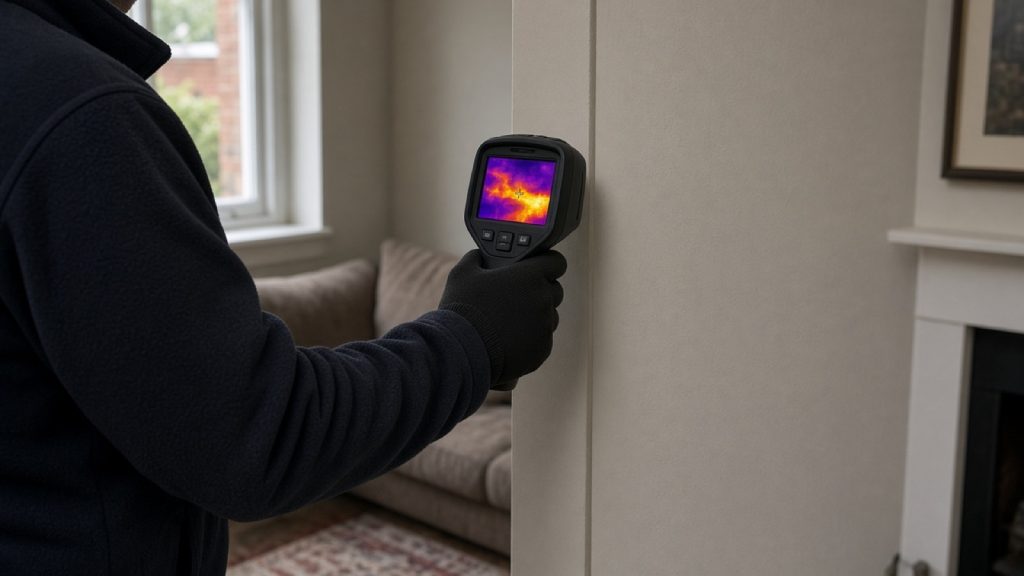
An infrared camera shows the temperature pattern of a floor or wall. A heating leak under screed shows as a warm bloom, and a cold mains leak as a cool streak, without lifting a tile.
Ground microphones and contact sensors pick up the hiss of pressurised water escaping. It is the main tool for mains and underground supply pipes, including long private pipes on rural plots.
A safe hydrogen and nitrogen mix is put into a drained heating circuit or supply pipe. It escapes at the leak, rises through screed, concrete or soil, and a sensor finds it at the surface.
Around Stowmarket a modern house on a screed floor was losing heating pressure, and tracer gas pinned the leak to one tile in the kitchen. In Ipswich a Victorian terrace had a wet cellar that the ground microphone traced to the supply pipe under the front path. A timber framed house in Bury St Edmunds had a damp wall which the thermal camera showed was a leaking heating pipe inside it, not rising damp. On the coast near Southwold a holiday let had a water bill for a month nobody had stayed: a split supply pipe under the shingle garden. And a farmhouse near Haverhill on a long private pipe from the lane had its leak found in the paddock.
Every Suffolk postcode is covered. These town pages have more on the local housing and the jobs nearby: Ipswich, Felixstowe, Stowmarket, Mildenhall, Beccles, Leiston and Redgrave. If your village is not named, call and ask.
Most home insurance policies include trace and access cover, which pays for finding the leak and for making good any opening up, separate from the repair. Our written report sets out the method used, the evidence from the camera or sensor, the exact location and our recommendations, in the form insurers ask for. Check your policy wording before you book.
Call us on 07897 020 680 any time, or 01440 840 772 in office hours, for the earliest slot in your part of the county.
Landline 01440 840 772. Email hello@completeleakdetection.co.uk.