A soft patch that never dries
One area of lawn stays spongy through a dry spell, or the grass grows greener in a line or a circle. Water from a buried pipe feeds the roots long before it reaches the surface.

Buried pipe leaks
A leak in a buried pipe can run for months with nothing to show but a soft patch of lawn and a bigger bill. Charlie traces the pipe, puts tracer gas through it and marks the leak on the surface before anyone digs.
Tracer gas pinpointing
Pipe route traced first
No find, no fee
Driveways left intact
Tell us what you have noticed and where. We ring you back to talk it through. No find, no fee.
No find, no fee
24/7 enquiries
Non-invasive methods
Reports for insurance claims
Underground water leak detection is a different job from finding a leak inside the house. The pipe is anywhere from 450 mm to over a metre down, its route is rarely where the drawings say, and the ground above it may be lawn, block paving or concrete. Digging on a guess ends with three holes and no leak.
The pipes that fail underground are the supply pipe from the stop tap to the house, long private supplies to farms and rural properties, feeds to outbuildings and garden taps, and the runs between buildings on commercial sites. Older alkathene and galvanised steel are the usual suspects.
Finding underground water leaks starts with proving the leak exists on that pipe, then tracing where the pipe runs, and only then pinpointing. Charlie does all three on one visit and marks the ground before anyone picks up a spade.
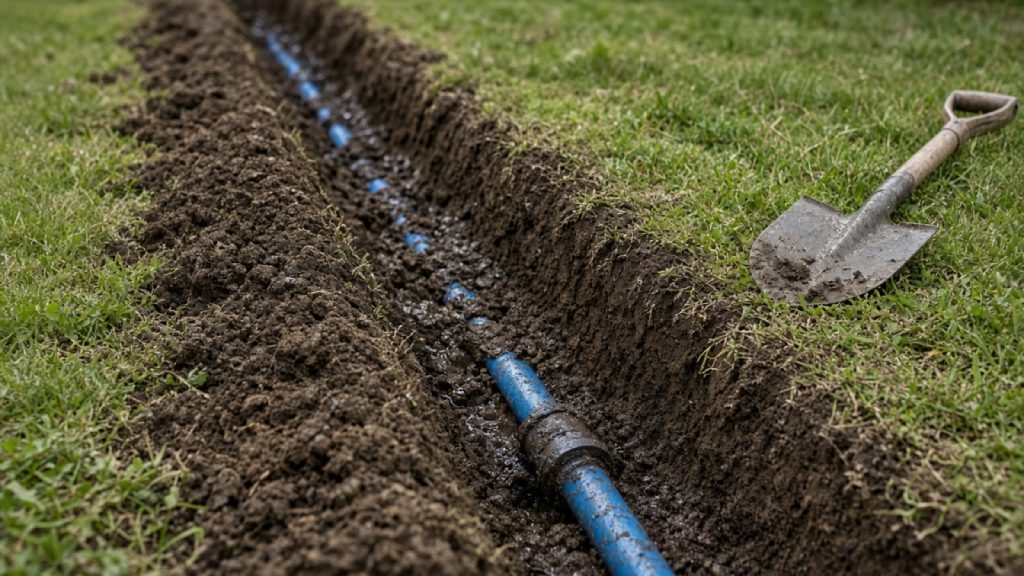

One area of lawn stays spongy through a dry spell, or the grass grows greener in a line or a circle. Water from a buried pipe feeds the roots long before it reaches the surface.
Close the internal stop tap and read the meter at the boundary. If it keeps moving, the leak is on the pipe between the two, which is underground and your responsibility.
A boundary box that is always full of water, with no rain to explain it, usually means the supply pipe is leaking close to the stop tap or the joint under the box.
Anglian Water, Cambridge Water, Affinity and Thames Water all write out when a meter shows continuous flow. The letter confirms the leak but not where it is; finding it is our job.
1
A meter test with the house isolated, then a pressure test on the supply pipe alone. This separates a buried leak from a leak inside the building and tells us roughly how much water is escaping each hour.
2
An electronic locator follows metal pipe directly, and a sonde or the tracer gas itself follows plastic. Charlie marks the actual route across the garden or drive, which is often nothing like a straight line.
3
Acoustic ground microphones first, listening along the marked line. Where the ground is soft or the pipe is plastic, tracer gas finds the point. The leak is painted on the surface, measured from a fixed point and written up.
A hydrogen and nitrogen mix is put into the drained pipe under pressure. Hydrogen escapes through a hairline split and rises through clay, gravel, concrete and tarmac to the detector at the surface.
A ground microphone on a long handle amplifies the noise of water leaving a pressurised pipe. Our engineer walks the marked route listening at close intervals, and the loudest reading sits over the leak.
Water from a leak changes the surface temperature of the ground above it, cooler in summer and warmer in winter. On a drive or patio the camera can show the wet area before anything is visible.
An electromagnetic locator traces the route and depth of metal pipes and of any plastic pipe with a trace wire or a sonde inside it. Knowing the route before listening keeps the number of holes to one.
A cottage on the north Norfolk coast had a private supply running 80 metres from the lane, and a meter turning with every tap off. We traced the route with a locator, listened along it with the ground microphone and found a split where the pipe passed under a field gate, so the dig was one hole. In the Fens near Manea a farmhouse supply ran through soft peat and gave no sound; tracer gas surfaced at a corroded coupling halfway across the paddock. Outside Diss a bungalow had a soft, green patch of lawn in a dry August: a feed to a garden tap leaking a metre down, found with the gas and marked for the groundworker.
We are based in Suffolk and cover Suffolk, Norfolk, Cambridgeshire and Essex for underground work, with Hertfordshire, Bedfordshire, Buckinghamshire and Greater London by arrangement. Rural properties on long private supplies are a regular part of the diary. Visits are usually booked within 24 to 48 hours.
Short, practical reads written for the problem you have in front of you.
Trace and access cover often applies to a buried supply pipe as well as to pipes inside the house, and some policies carry separate underground pipe cover. The report gives the insurer the meter and pressure test results, the traced route, the marked position with photographs and a note of what needs digging up.
Call 07897 020 680 with your meter reading and a rough idea of where the pipe runs; we can usually book you in within 24 to 48 hours.
Landline 01440 840 772. Email hello@completeleakdetection.co.uk.