Water under the sink or around the toilet
A puddle under the kitchen sink or at the base of the toilet is often a joint or a waste connection rather than the fitting itself. It can be a slow drip that only shows after use.

Plumbing leak detection and repair
A plumber who cannot see the leak will start opening things up. Charlie finds it first with thermal imaging, listening equipment and tracer gas, then repairs it, so the only hole is the one over the leak.
Find it, then fix it
No find, no fee
One engineer, one visit
Usually booked within 24 to 48 hours
Tell us what you have noticed and where. We ring you back to talk it through. No find, no fee.
No find, no fee
24/7 enquiries
Non-invasive methods
Reports for insurance claims
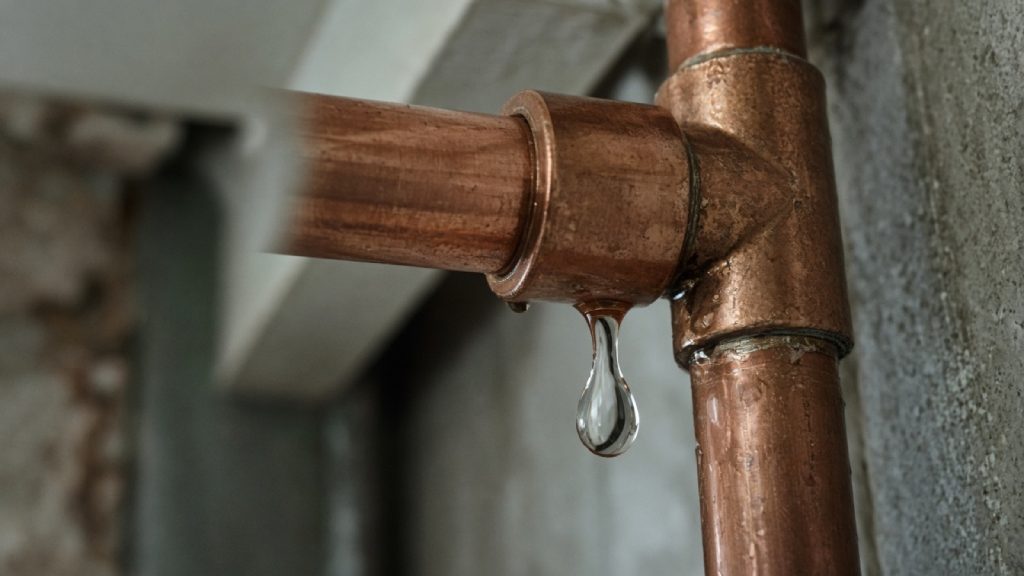
Most plumbing leaks are small and hidden. A weeping compression joint under a bath. A pinhole in a copper pipe in the kitchen wall. A push fit that was never quite home behind a boxed in pipe run. The water shows up somewhere else, often a room away, and the usual response is to start pulling things apart until it is found.
We do it the other way round. Charlie does the plumbing repair as well as the detection, so the first hour of a visit is spent finding the leak without damage. Once it is marked, the repair is a normal plumbing job on a known pipe at a known spot.
This is the page for plumbing leak repair in the house itself: supply and feed pipes, hot and cold runs, waste pipes, toilet and cistern connections, kitchen and bathroom pipework. For a leak on the mains pipe outside, see water mains leak detection.
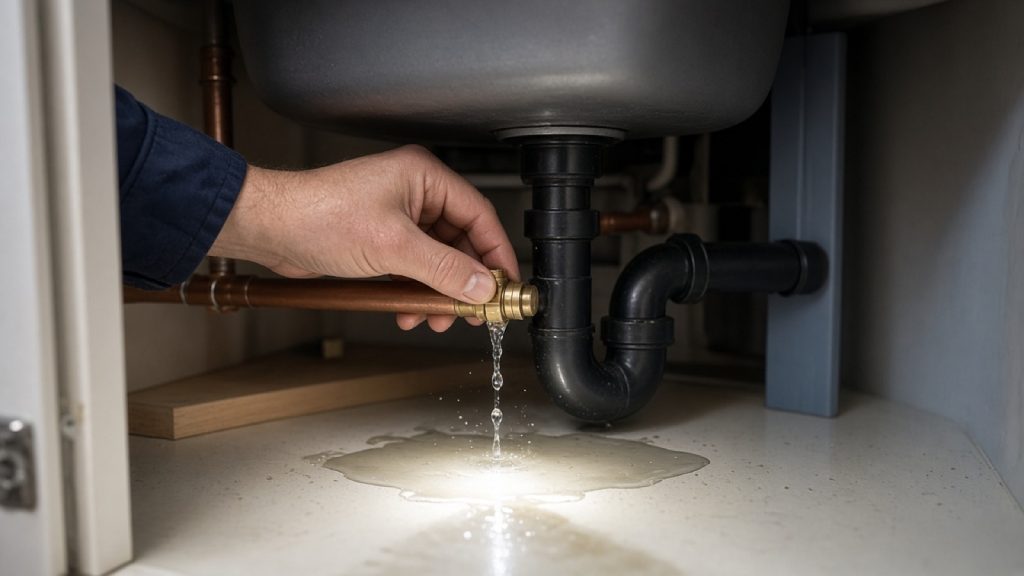
A puddle under the kitchen sink or at the base of the toilet is often a joint or a waste connection rather than the fitting itself. It can be a slow drip that only shows after use.
A yellow or brown mark on the ceiling under a bathroom usually means a pipe joint or the bath or shower waste is leaking under the floor. The stain is rarely directly under the leak.
A hidden drip on a feed pipe runs all day and all night. If your usage has not changed but the bill has, somewhere a pipe is letting water out, and the meter will prove it.
A cistern that refills when nobody has flushed has a valve or flapper passing water. It wastes a surprising amount and is one of the easier plumbing leaks to repair.
1
Charlie checks the meter with the stop tap on and off, and tests the heating pressure, to tell a supply leak from a heating leak from a waste leak. Each one is found differently.
2
The thermal camera finds the wet area. Listening equipment or tracer gas pins the leak to a point on the pipe. A moisture meter confirms it. The spot is marked before anything is opened.
3
With the leak marked, Charlie opens the smallest area needed and repairs the pipe or joint. Where a fitting has failed he replaces it. You see the leaking section before it is removed.
4
The system is refilled, pressurised and checked. You get a written report with the location, photos and what was done, which is what an insurer needs for a trace and access claim.
The camera shows the temperature change a leak leaves in a wall, floor or ceiling. It is the quickest way to find where the water is and to follow it back towards the pipe that is feeding it.
Contact sensors on pipes and fittings pick up the noise of water escaping under pressure. Useful for pinholes in copper and weeping joints inside walls and boxing.
For a leak that makes no noise, we drain the pipe and fill it with a hydrogen and nitrogen mix. A detector reads where the gas surfaces. It works on plastic pipe and under thick floors.
Isolating a section and watching whether the pressure holds proves which run is leaking before any locating starts. It also proves the repair afterwards.
A bungalow in a Mid Suffolk village had a damp patch at the bottom of the airing cupboard wall. The thermal camera showed a cool stripe behind the plaster and a moisture meter put it at a compression joint on the hot feed, repaired through a hand sized opening. In an Ipswich terrace a kitchen cupboard was always wet at the back; the culprit was a pinhole in the copper pipe inside the wall, heard with a contact microphone and replaced the same morning. In Southend a push fit under a bath, never fully home, had been dripping onto the ceiling below for months. The bath panel came off, the fitting was replaced, and nothing else was touched.
Plumbers leak detection and repair from our Suffolk base across Suffolk, Norfolk, Cambridgeshire, Essex, Hertfordshire, Bedfordshire, Buckinghamshire and Greater London, in postcode areas AL, CB, CM, CO, EN, HP, IG, IP, LE, LU, MK, NN, NR, PE, RM, SG, SS and WD.
Short, practical reads written for the problem you have in front of you.
Trace and access cover on a home policy pays for finding a hidden leak and for putting right what was opened to reach it. Because one engineer finds and repairs the leak, the report covers both in one document: where the leak was, how it was confirmed, photographs of the pipe before and after, and what was replaced.
Call 07897 020 680 and we can usually book you in within 24 to 48 hours, with no find, no fee on the detection.
Landline 01440 840 772. Email hello@completeleakdetection.co.uk.